Blog
Faculty Rally for Fair Contract at Dixon University Center
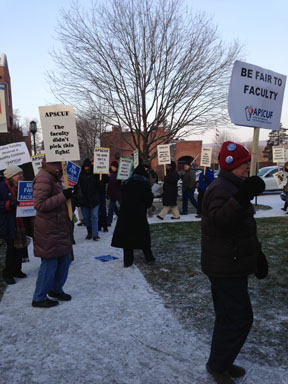
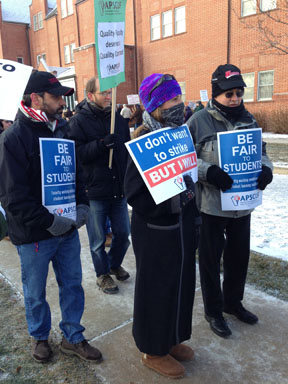
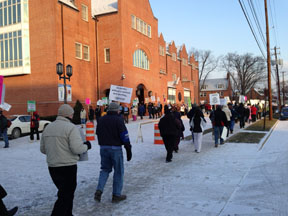
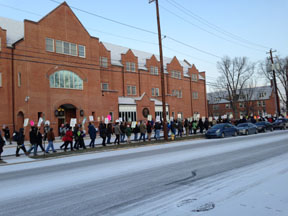
This morning, hundreds of APSCUF faculty convened at the Dixon University Center in Harrisburg to rally for the settlement of a fair contract. Buses brought faculty from across the state for a protest that was held before and during the PASSHE Board of Governors meeting. Though negotiations have been ongoing, parties still remain divided on issues of active and retiree healthcare, distance education and class size and curriculum. APSUCF faculty do not want to strike–it’s a last resort–but they remain committed to the fight for a fair contract and preservation of quality education for Pennsylvania students.
APSCUF and PASSHE fail to reach agreement at latest negotiations session
APSCUF and PASSHE negotiators met January 16 for approximately six hours. The parties exchanged proposals involving distance education and both active and retiree health care, but did not reach any agreements. There were also substantive discussions concerning curriculum and class size. The session concluded when the Chancellor’s team suggested that it will provide APSCUF with a new comprehensive proposal before the next scheduled negotiation session on February 1. Given the current status of talks and the distance between the parties on key issues, APSCUF is planning for faculty to attend the PASSHE Board of Governors meeting on January 24. Faculty from all 14 of the state-owned universities intend to show their support for their negotiations team and to express disappointment with PASSHE’s unwillingness to conclude an agreement after two years of discussions.
PASSHE-union contract talks: The faculty’s view
The following is a Letter to the Editor from APSCUF Vice President, Ken Mash, which ran in the Pocono Record on January 13, 2013.
Why does the prospect of a strike loom at East Stroudsburg University and the 13 other state-owned universities? It’s really quite simple: the chancellor and his representatives at the Pennsylvania State System of Higher Education (PASSHE) have not dealt fairly with their faculty.
In June 2011, Gov. Tom Corbett quickly settled what he called “fiscally responsible” contracts with the commonwealth’s largest statewide public-sector unions. Those contracts exchanged modest salary increases for some minor additional health care contributions. The Association of Pennsylvania State College and University Faculties (APSCUF) has already agreed to similar modest wage increases and offered considerable health care concessions.
In contrast to the governor, who quickly tried to be fair to both taxpayers and employees, the chancellor’s representatives began negotiations with 36 proposals attacking virtually every section of the faculty contract. Clearly, the plan was to use the national economic crisis as an opportunity to take advantage of faculty regardless of how it might impact our students’ educations or our careers. Fortunately, my organization has fought off most of PASSHE’s outrageous proposals.
Still, after two years of struggle, the chancellor continues to seek concessions from APSCUF faculty that were requested of none of Pennsylvania’s other unions. They want us to accept a proposal that would drastically alter retiree health benefits. While liabilities for retiree benefits are a concern, they are a concern for the entire commonwealth. Yet, only the faculty have been asked to make these major changes.
PASSHE wants to eliminate or reduce payments for distance education course preparation and delivery. PASSHE has asked for these reductions without assuring APSCUF that there are staff, other than our faculty, available on the campuses with the necessary technological skill to design quality courses for our students. PASSHE has also not yet sufficiently dealt with our concern that students will be steered into mega-sized distance education courses whether or not it is their desired educational experience.
Despite our concessionary proposals on health care and our suggestions that would save the State System millions, PASSHE’s representatives seek major redesigns to faculty health care benefits at considerable cost to my colleagues. No other union was asked to redesign its health care plan. These proposals are particularly egregious since faculty members already pay the highest percent of premium of any union in the state.
In op-ed pieces across the commonwealth, Gary Dent, the system’s vice chancellor for human resources and labor relations, has asserted that he is the person directly responsible for advising the chancellor and Board of Governors about the contract. His assertions of responsibility seem odd to us. As the chair of the faculty negotiations team, I can personally attest to the fact that, unlike his immediate predecessors, Mr. Dent has been totally absent from the actual negotiations. Instead he has added a level of bureaucracy to an already difficult process by counseling the other side from the comfort of his office.
Mr. Dent repeatedly makes the misleading claim that PASSHE has reached agreements with its other unions. In fact, the State System has completed agreement with no other union with respect to health care design. The major statewide unions negotiate with the commonwealth. The other unions that deal directly with PASSHE tied their health care to management’s. Since managers have the same health care benefits as faculty, the reality is that these unions will receive the health care plan that APSCUF negotiates.
Faculty do not want to go on strike. We love our work, and we want to educate our students. We also want a fair contract. To avoid a strike, we have offered an extension of the existing contract, binding arbitration, and multiple concessions. The chancellor and his representatives have turned all of these proposals down. Nineteen months ago, the governor laid out how to achieve a responsible contract. If the system truly wants to act in the best interests of students, it should follow the governor’s blueprint and settle a fair contract with faculty.
Ken Mash is a distinguished professor of political science at East Stroudsburg University and he is the State Vice President of the Association of Pennsylvania State College and University Faculties. He is the chair of the faculty negotiations team in contract talks with the state system of higher education.
Negotiators make progress; still divided on significant issues
APSCUF and PASSHE negotiators met on Friday, January 11. The parties reached several tentative agreements affecting compensation. Other discussion centered on distance education, curriculum committees, and class size. Although there has been progress, there remain significant divides on these issues and active and retiree and health care. The parties meet again on January 16. In the interim, the faculty continue to prepare for all contingencies.
Progress made during latest negotiations session; health care remains an issue
APSCUF and PASSHE negotiators met for six hours on Friday, January 4, 2013. The meeting was marked by several long breaks as the APSCUF team waited for the Chancellor’s representatives to present counter proposals. There was some important progress; most notably PASSHE took its proposal for a temporary faculty salary freeze off the table. Active and retiree health care and distance education remain topics where there are still significant divides. PASSHE has not yet negotiated a health care package design with any of its employees not in the Pennsylvania Employees Benefit Trust Fund, and it falls to APSCUF to negotiate this benefit. The parties meet again January 11. Meanwhile, the faculty continue to prepare for collective action should it be necessary to obtain a fair contract.