
Blog
APSCUF president talks consolidation, funding, retirements
APSCUF President Dr. Jamie Martin discussed faculty retirements, consolidation and state funding on an episode of “Pennsylvania Newsmakers” recorded this month.
“The solution is appropriate levels of funding for our students and for our universities,” she told host Dr. G. Terry Madonna, a past APSCUF president. “It becomes an issue of, ‘Are we going to value this?’ Do we care about our young students, especially those who are first-generation, maybe from middle- to lower-income families and from underrepresented groups? Do we care about their opportunities as they’re moving into higher education or not? So, it is a matter of funding, and without that, we’re probably going to see additional kinds of cuts and a lack of opportunities.”
Click here or on the embedded video above to watch the full interview.
Martin discusses unanswered consolidation questions in interview
APSCUF President Dr. Jamie Martin talked about consolidation, retrenchment and retirements during an episode of “Behind the Headlines” recorded last week. She discussed low faculty morale, how APSCUF is still trying to understand the rationale for consolidation, and unanswered questions about programs, online classes, athletics and more.
“I think there are just all of those questions, and we’re moving down this train track pretty quickly without the answers to those,” Martin said of consolidation. “And I recognize we can’t have answers all at once, but those are big decisions that we don’t yet have.”
Click here or on the embedded video above to watch the full interview.
See Dr. Christopher Hallen’s remarks to the Board of Governors – Dec. 1, 2021
The Dec. 1 Board of Governors meeting took place via Zoom and streamed via YouTube. Below are APSCUF Vice President Dr. Christopher Hallen’s comments as prepared.
Chairperson Shapira, Chancellor Greenstein, governors of the Pennsylvania State System, university presidents and guests,
I appreciate this opportunity to present a faculty-union perspective as we sail on through the rough seas of consolidation. As you know, APSCUF represents about 5,000 faculty and coaches at the 14 campuses of the State System of Higher Education, and I’m proud to serve them as vice president with my BFF, President Martin, who is unable to be here due to a schedule conflict.
I’d like to give you a view from the trenches. Frankly, morale is low, lower than I remember seeing it. Morale is lower than the late 1980s and early 1990s, when department budgets were shrinking and the ability to replace equipment in teaching labs or classrooms was difficult, when having a phone turned on in a faculty office after 4:30 was a presidential decision. As a young analytical chemist, I had to call a service tech at Varian Corporation at 3 in the afternoon their California time. The very understanding chair and I had to use his office phone with him muttering about dinner. Back in these days, a big question was if a department or maintenance was responsible for purchasing paper towels, toilet paper or chalk.
Morale is lower than the “silos of excellence” era when the System, under Chancellor Judy Hample, tried to focus campuses into regional centers for science, arts, music. That “how” was too big a leap, and this effort was stopped by the next chancellor, when it was eventually shown to cost more than it saved. Morale is lower than the days of ballooning enrollments — because the only way to get more money to your institution was to bring in more bodies, become bigger than “them” and satisfying “The Formula.” This led to ill-prepared students side by side with true student scholars; more remediation work in lower-level classes, attempting to help some and boring others; burgeoning class sizes; frustrated students, faculty and administrators. These heady days are now being hailed as our finest hour, when we were “sustainable.” Not as I and my colleagues recall. I almost quit in 2010, as the enrollment of my introductory chemistry class went from 25 to 45 to 61 to 130 in a decade. I stopped being value added — with assigned papers connecting students to the science and full written exams — to spending hours on Excel or a variety of D2L packages trying to get my Scantron results into the grading package without screwing it up. Being more a traffic cop trying to figure out logistics (How many different-colored exams do I need to stop cheating?) than a purveyor of fine knowledge. Students complaining about scheduling for classes — not because it wasn’t available but because the one section conflicted with something else.
Flash to now. We have a pandemic in action. If I thought cheating was hard to monitor in a classroom, the stories my colleagues tell curl my beard. I chose a hybrid approach at the sophomore level, where students could come to lab or watch from home. It took one period for me to realize I was in trouble, that the technology for real-time Zoom in a lab was not there, that the background noise meant I had to hug the computer in front of the lab and hope no one hurt themselves in the back, that to help students in class resulted in ignoring those at home and vice-versa, that an iPad battery does not cover a four-hour lab and available bandwidth causes slowdowns. My students in lab finished on time. Those at home finished 25 or more minutes later — both of them still online anyway. You can imagine the enthusiasm ALL of us had for lab 2. Get out the duct tape. Similar issues happened in “Zoom classrooms,” where it was determined if you walk over there to point out something on say a periodic chart, you vanished from home unless the picture was so small it was impossible to see or someone moved the camera. And forget about voice! Either you were heard or students present were heard or the students at home were heard. And no writing on the whiteboard was large enough. This fall, although many of the faculty openly questioned what was being done by the System to protect them from Covid, there was relief to get away from the challenges of the Zoom world. Yes, it works for meetings when everyone is in place — prim and proper and playing with their cellphones. Except for the prim and proper, are students any different? Zoom is not so great in a hybrid or mixed modality class. Someone loses out. Someone has a lessened experience. And as your faculty, we all hope the Omicron derivative doesn’t start the whole process over in the Spring or next fall. If so, we the faculty would like more active leadership from you.
My colleagues and I wonder if we are doomed to a lifetime of overload, as retired (or retrenched) faculty are not being replaced, and somehow it makes more sense to pay me over twice what they could pay an adjunct for the same course. We are told it’s because of the student/faculty ratio formula. Another formula as history repeats. Perhaps we should change the formula so that cost savings can be realized with the ratio. Right now, we’re combining sections, cancelling sections, making it harder for students to get classes. 2010 all over again, with students complaining about scheduling for classes — not because it isn’t available but because the one section conflicts with something else.
My colleagues and I are wondering whether we are next — next to be retrenched as our departments enrollments drop below a magical, moving-number target. A drop that can easily be caused by a program array. Why, for example at Penn West, must all pre-medical students be registered as biology majors? Nothing wrong with biology, but medical schools are open to many majors and degree paths. Shouldn’t we let the student decide what they want to major in — more student opportunity, not less? Is anyone asking students in the North Central region what they would think of completely moving campuses to get the program they want or of doing a 2+2 design?
My colleagues and I wonder if we will have secretarial support in the New U’s. Heck, we wonder if the State System will even be here when our younger colleagues’ children need it! We and our students wonder how the consolidated university is going to work. Wonder why a student will come to a North Central or Penn West if they will need to take online courses or move between campuses. Why not go to Slippery Rock and stay on campus? Or Penn State? Or, due to lessened state support which has made Bloomsburg more expensive, go to Gettysburg because with financial aid it’s about the same cost? We wonder when will we get a real name; of course, I have colleagues at the Western University who wonder the same thing. Penn West. Sounds like a prison. Are we saying that higher ed is a prison? And parole is a huge debt to be paid. What do we tell parents at open houses when they ask if such and such a program will be available for their child at The University to be Named Later? When will we know if the NCAA will allow my team, my mascot to survive? Over the summer, I had a lovely chat with a couple Mansfield students. One told me if she had to transfer to Bloomsburg for her major, she would never make her sports team; she wanted to know what would happen to her scholarship. While I’m thinking about the students: During the summer, I recall suggestions from more than one board member to get student opinions as this iterative process continues. I must have missed the chancellor’s visit to Bloomsburg so he could ask student opinions now they are back on campus. From a livestream event in mid-November hosted by student newspapers at the north central universities, it seems students still have lots of questions.
I’m tired of consolidation, and I’m not alone. And we have barely started with hundreds of issues that need resolution. I and my colleagues have been assigned the “how” with our local administrators. A bunch of exhausted, worn out, low-morale, getting-older-by-the minute, wishing-I-could-retire, glad-the-semester-is-winding-down professionals.
Thank you for this opportunity to express the views from ground level.
Past APSCUF intern was ‘dedicated union brother’
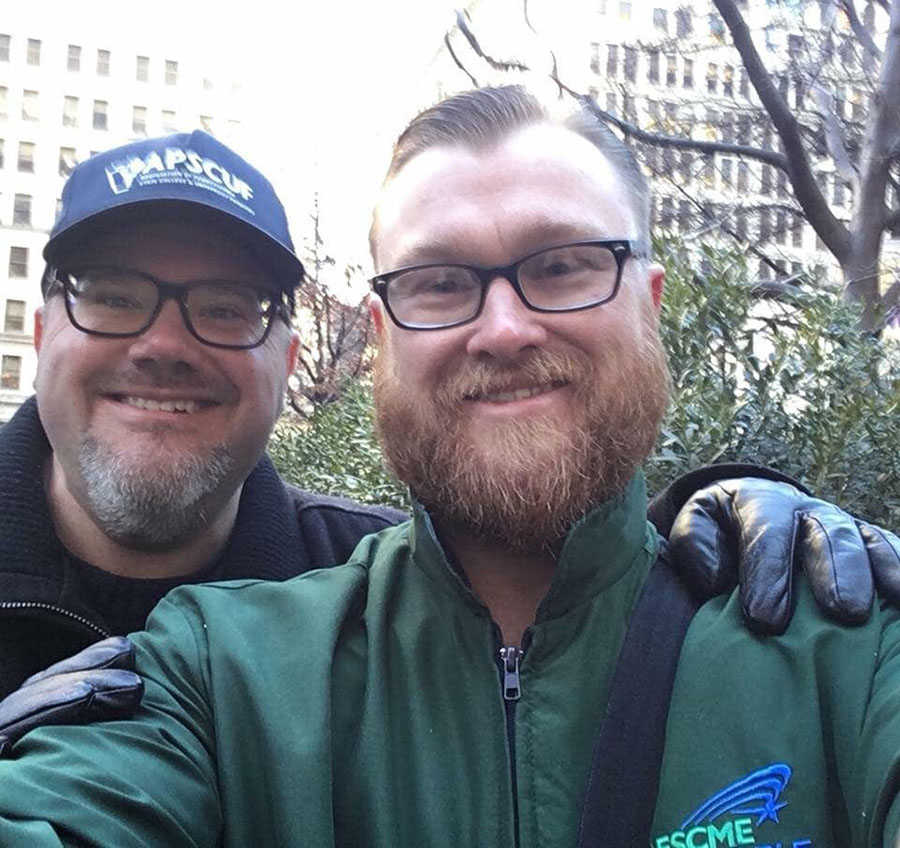
Clarion University Professor Kevan Yenerall, left, and Zach Hause. Photo courtesy of Kevan Yenerall
APSCUF is mourning the loss of a past State intern, Zach Hause, a 2008 Clarion University graduate who went on to work for AFSCME.
“He was a renaissance man of sorts, and a true friend of APSCUF and his AFSCME family,” said Dr. Kevan M. Yenerall, professor of political science at Clarion University, who taught and advised Hause. Yenerall described Hause as a friend and “dedicated union brother in the cause of good trouble.”
Click here to read Hause’s obituary. Click here to visit the campaign to support Hause’s family.
Martin talks consolidation, affordability, funding, retrenchment in interview
APSCUF President Dr. Jamie Martin discussed consolidation, affordability, retrenchment and funding during an episode of “The Rick Smith Show” this week.
“I don’t understand the ‘why’ of this,” Martin said of consolidation. “We’ve heard a lot that we have to do something. I kept trying to say, ‘Maybe we should make sure we’re doing the right thing and not just some thing.’ But this train is rolling down the tracks, so we’ll keep asking the questions that we need to ask as we’re moving forward, but the ‘why’ isn’t clear to me.”
On funding for Pennsylvania’s State System of Higher Education universities, she said, “I see this as a moral choice, an ethical choice. What is it we’re willing to fund? What is we want to fund, and what is it we’re choosing not to?”
Click here or on the embedded video above to watch the full interview. The link is cued to play at the start of Martin’s segment.