
Blog
Chancellor updates legislators about consolidations – May 2021
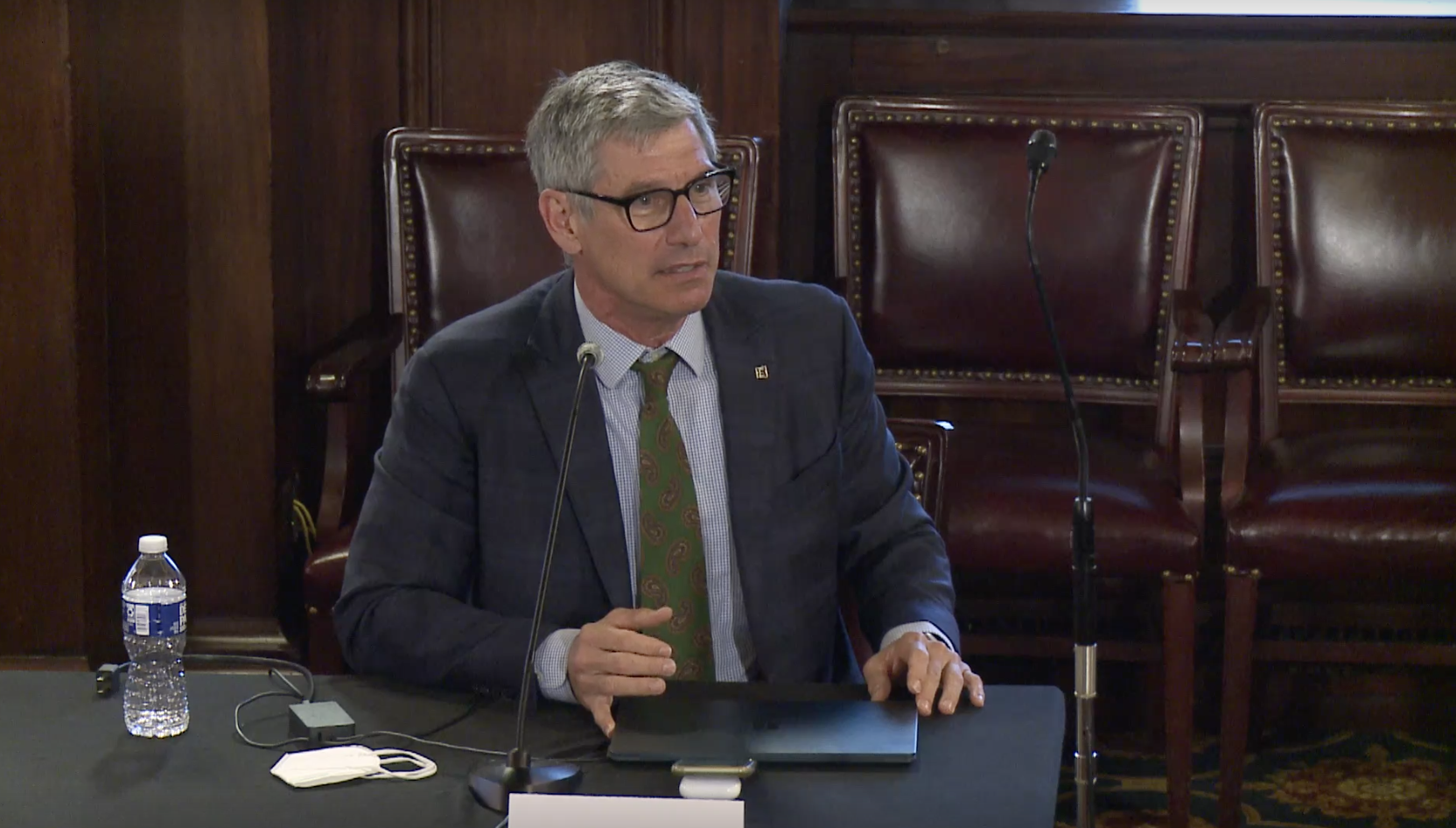
Photo/Pennsylvania House footage
As required by Act 50 of 2020, Chancellor Daniel Greenstein updated legislators about Pennsylvania’s State System of Higher Education’s consolidation plans at a joint and House appropriation- and education-committee hearing today. Click here to watch full hearing footage. Read APSCUF’s collated tweets from the hearing below:
Chancellor updates legislators about consolidations – April 2021
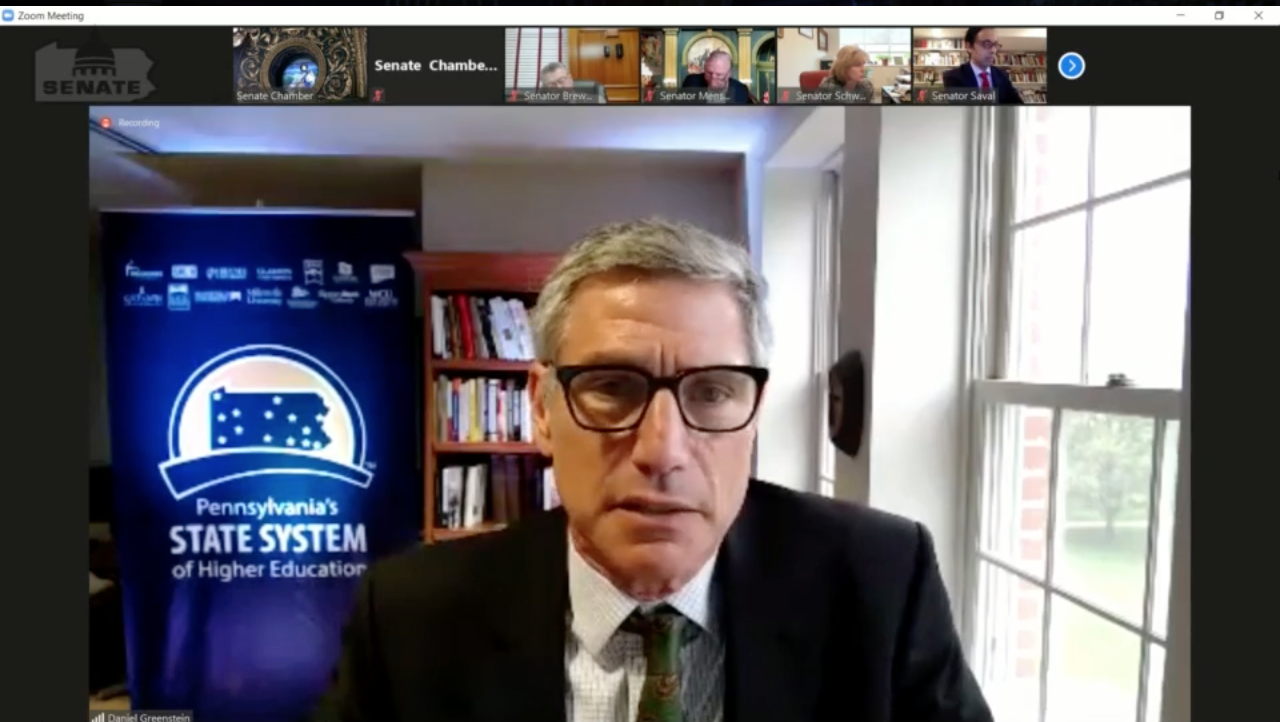
Photo/Pennsylvania Senate footage
As required by Act 50 of 2020, Chancellor Daniel Greenstein updated legislators about Pennsylvania’s State System of Higher Education’s consolidation plans at a joint and Senate appropriation- and education-committee hearing today. Click here to watch footage of the hearing. Read APSCUF’s collated tweets from the hearing below:
Following plan release, APSCUF stands united for Day of Action
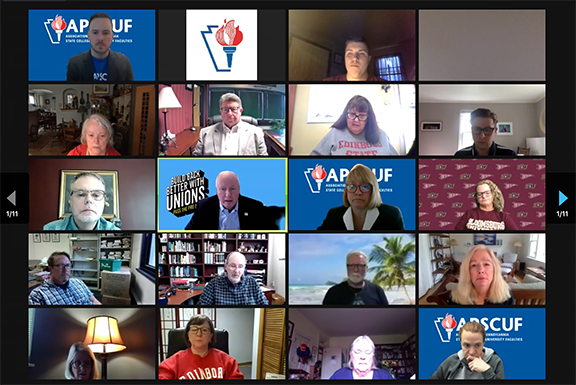
Rick Bloomingdale, third row, second from left, shares a message of solidarity with APSCUF. He is president of Pennsylvania AFL-CIO. Photo/APSCUF
After Chancellor Daniel Greenstein presented university-consolidation plans at Wednesday morning’s special Board of Governors meeting, APSCUF members and other advocates leapt into a Day of Action to strategize how stakeholders can make their voices heard.
APSCUF faculty, coaches and retirees began with a members-only meeting to discuss concerns about the plan, many of which Dr. Sam Claster, an Edinboro University APSCUF officer, voiced in his comments to the Board of Governors. Members may log into the APSCUF website to view a members-only toolkit containing contact information, talking points, research, links to news articles and other advocacy resources.
Save Our State Schools (a growing coalition of students and families, staff, coaches and faculty, and local business owners working together to protect State System universities and the communities that host them) presented a streamed event to discuss advocacy surrounding the plan. Register for SOSS email alerts to hear directly from them. PA Publics, a group of alumni and friends fighting for a flourishing State System, described its work and ideas for future action.
A 4 p.m. rally and press conference attracted more than 200 members, students, representatives from other labor unions, staff and reporters. Special thanks to guest speakers Rick Bloomingdale, president of Pennsylvania AFL-CIO; David Henderson, executive director of Council 13 of the American Federation of State, County and Municipal Employees; and Kyle Schlecht, Lock Haven University student. Click here to watch the event recording.
To learn more about consolidation and APSCUF concerns, as well as for details about how students, alumni and other stakeholders can take action, visit the consolidation area of APSCUF’s Students page. APSCUF will continue to update the page as we delve deeper into the State System’s 439-page consolidation report.
As the day wound down, APSCUF President Dr. Jamie Martin issued the following statement:
“We were disappointed by the lack of detail in the 439-page report presented to the Board of Governors today. The State System’s consolidation plans fail to address many questions and concerns stakeholders raised throughout the 10 months before the plans’ release. Questions remain about forced hybrid learning for our students, whether our student-athletes’ teams will exist, and the economic community impacts, for example. What we did learn from the plans is that the costs of consolidation are much greater than the savings that will be realized. We were shocked by this. Given the lack of detail and unanswered questions, and the lack of any financial savings, APSCUF cannot endorse or support these consolidation plans.” —APSCUF President Dr. Jamie Martin

See Dr. Sam Claster’s remarks to the Board of Governors – April 28, 2021
The April 28 Board of Governors special meeting took place via Zoom and streamed via YouTube. Below are Edinboro University faculty member Dr. Sam Claster’s comments as prepared.
Chairwoman Shapira, Chancellor Greenstein, governors, presidents and guests,
It is my absolute honor to represent APSCUF and about 5,000 of my faculty and coach colleagues across our 14 publicly funded state-owned universities.
I grew up on Fairview Street in Lock Haven, and my family owned a few small businesses which only thrived because of the university in our town. As an Edinboro alum, I’m proud to also be a current faculty member and department chairperson there. Over the past few months, I’ve led the curricular synthesis of my discipline for the Western integration and have served on two working groups. Through these roles, I’ve developed an intricate knowledge of the consolidation plan, and I am here today to share some concerns that my colleagues and I have regarding its potential implementation.
APSCUF’s first concern about the plan to consolidate six of our institutions down to two, is that while there is some brief information about community impact in the report, it is not as in-depth as we would hope for a project of this magnitude, such as the economic-impact report the State System issued in 2015. The plan briefly mentions the general economic impact of our singular institutions, but lacks any depth regarding impacts of the proposed consolidated entities.
To this end, the PERI report released this week (PERI is the Political Economy Research Institute at UMass Amherst) demonstrates that consolidation and the corresponding planned reductions, as reflected in campus financial sustainability plans, would have a devastating impact on our communities. The planned cuts at the Eastern Consolidated University totals 20% of its workforce, and the Western Consolidated University totals 26% of its workforce by 2023. Beyond the unacceptable consequences for individuals who will lose their jobs, the spillover effects will cascade through the regional economy, resulting in spikes in poverty rates. These local economies cannot sustain this level of damage. I urge board members to review this report, and very seriously consider its implications.
When Chancellor Greenstein visited Edinboro last month, I voiced a concern regarding Bloomsburg and California being designated “main” campuses, and the other four locations being designated as “branch campuses” or “other teaching locations,” as the plan describes, because of the Middle States accreditation rules regarding multi-campus designations. APSCUF understands the reasons stated for why Bloom and Cal were designated “main campuses.” They’ve gone through accreditation more recently, but that is not our concern. We need a definitive answer from Middle States about the structural and legal consequences of this designation. In other words, can these “branch campuses” be divested of and simply closed in time?
I genuinely believe the chancellor when he says that the financial and human costs of closing one of these campuses would be insufferable for our communities. If this concern is genuine, then getting this information should be a priority. I would hate for a board approval of these consolidations to have the devastating unintended consequence of closing a university and decimating a small town. This would put the board in a very bad position. Moreover, our current chancellor may not intend to close campuses, but who is to say that a future chancellor will not.
In a similar vein, the plan states that athletic programs and events will remain available at all integrating campuses. Which is then contradicted in the section titled “risk to athletics,” where the report is clear that the NCAA has not yet ruled on the proposed structure. Our athletes come to the Commonwealth from all over the country and even the world, and they often choose employment in Pennsylvania after graduation. They have the highest retention rates of all our student groups. It would be irresponsible for the board to approve this consolidation before the NCAA gives its determination as to whether individual campuses are able to retain their own athletics programs.
In fact, I would ask the board members to ask yourselves what your recommendation regarding consolidation will be if the NCAA does not permit independent athletic teams. What will you say to alumni? To donors? How will we recruit for our institutions?
To be honest, every day that passes with uncertainty surrounding consolidation increases the risk of potential damage to our individual brands and, consequently, to our enrollments. Some of our consolidating institutions are seeing a significant increase in unregistered students compared to this time last year. These are students who should be continuing their education with us next fall, and their potential departure signals an issue well beyond the impacts of COVID.
The rapid pace of the consolidation process has no doubt manifested a declining confidence in our six institutions. An unnecessary and unfounded decline in confidence as faculty like myself, who work day in and day out with our students know the truth. Many of our institutions have financial challenges, yet they continue to do what they do best: provide pathways to upward mobility for working class Pennsylvanians, even as state investment remains some of the lowest levels in the nation.
With regard to the proposed costs and projected savings of the consolidations — $29.6 million is the estimated investment cost, while the projected savings is just 18.4 million over five years, all stemming from the contraction of the upper managerial organizational structure. An organizational structure which may or may not be adequate to serve three separate communities.
The chancellor has said the consolidations are about opportunities, not savings, but if finances are a reason for increasing student/faculty ratios, (decreasing faculty), how will this increase opportunities for students? APSCUF members already saved the State System $25 million dollars in 2020–21 due to the early retirement incentive. That number would actually mean something if it weren’t for the auxiliary debt that has been the real financial burden to many of our institutions for some time. And yet the consolidation plan offers no solution for removing this albatross from our necks. Instead, the plan is quit clear that the Western integration will not result in financial savings precisely due to the auxiliary debt.
In closing, I would like to thank the board, the Office of the Chancellor, and all our colleagues across the System working on these consolidations. Not because I have confidence in the current plan, but because I know we all share a commitment to our students.
Regardless of the outcome of a vote to consolidate, I believe there will be good things that come out of this process. Even if it means that we need to change course, and rethink System redesign. Admittedly, I have been inspired by our collective desire to create a healthier PASSHE system, but a lot of questions about this current plan remain unanswered. There are simply too many to address in this venue.
I hope the right path is chosen for our students and for the future of our State System, once we’ve considered all of the data, as well as better understand the potential consequences for our communities.
Thank you.
The plans are up

The State System has posted the agenda and consolidation plans for Wednesday’s Board of Governors meeting, at which the consolidation plans are scheduled to be presented.
APSCUF is reading the plans carefully — through a lens that keeps student concerns at the forefront — and making sure the plans comply with Act 50.
We are planning advocacy events, including a virtual rally and press conference Wednesday afternoon. We’ll discuss how you can share your thoughts about the plan and how you can advocate for what is best for students and Pennsylvania. This event is open to the media and will include a press-conference portion. We encourage faculty, students and alumni to wear campus gear and to bring a small, handmade rally sign to display during the rally portion. Click here to register for the afternoon event and to view other advocacy activities scheduled for this week.
Members, click here (login required) to register for an APSCUF-members-only morning event.
Now is the time to make your voice heard.