Blog
Be confident with an open mind, APSCUF intern advises after summer in Harrisburg
Deciding whether or not to apply for an internship can be a difficult decision. During the application process, one has many factors to consider: What will I learn, will the experience be worth it, is the internship paid or unpaid, and how much will it cost to live where I’ll be working? In this post, I’ll try to answer some of the frequently asked questions prospective interns have, while also giving a brief overview of my experience at APSCUF in Harrisburg this summer.

APSCUF intern John Danvers, center, with Clarion University’s ASPCUF Chapter President Ray Feroz, left, and Clarion Professor Kevan Yenerall at APSCUF’s legislative reception in June. Danvers is an economics and political-science major at Clarion.
The acknowledgements
Before I begin, however, I want to recognize those who made this experience possible. Dr. Kevan Yenerall, my internship adviser, has played an indispensable role in my development and growth as I study Pennsylvania politics. His commitment to students is unparalleled, and I am grateful to have him as my professor and adviser at Clarion University.
Here in Harrisburg, I’d also like to express my gratitude to a few individuals. Kathryn Morton and Sean Crampsie, my internship supervisors, are incredibly talented professionals and have served as tremendous mentors during my time with APSCUF. Kathryn is the consummate communications director, and Sean knows our state legislature inside and out. Finally, I’d like to thank Dr. Mash and the APSCUF staff for their kindness and willingness to help me whenever I had a question or need.
The details
Here’s what you need to know about the internship. First, if financing a summer in our state’s capital is a concern, don’t let this stop you from applying. APSCUF provided an apartment while also paying $11 an hour to work 35 hours each week. My only notable expenses were for groceries and parking.
Over the course of my 10 weeks in Harrisburg, I shadowed lobbyists, interviewed legislative assistants, and met state representatives and senators. Also, I gained valuable public-relations skills, such as learning how to write a column for a newsletter and interviewing an APSCUF member.
A normal day for me would entail waking up around 6 a.m., going for a run (I’m training for a marathon.), then heading to work around 7:45 (I parked about a mile away from the office.). The work day runs from 8:30 a.m. to 4:30 p.m. with an hour for lunch. After work ended, I’d usually go to the gym for an hour, come home and eat dinner, then go to bed and recharge for the following day. It sounds boring at first, but it’s a process I came to love and embrace.
My advice to anyone interested in this program is to have confidence in yourself but go into every situation with an open mind. Be ready to learn. Ask questions. That’s what this entire thing is about. Also, don’t be afraid to put yourself out there. Harrisburg is a microcosm of any major political environment — and in a way is one in and of itself. Talk to people, get their cards, and follow up. Lastly, have fun. South central Pennsylvania is in proximity to the major metropolitan areas of Philadelphia, Baltimore, Washington D.C., and New York City. I even went up for a weekend to visit some family in Connecticut. Take advantage of this great opportunity to do some exploring and make your friends jealous while they sit by the pool all summer. Good luck!
—John Danvers, APSCUF intern
As fall expenses loom, student shares ways to save

Photo/Pexels.com
APSCUF believes quality, affordable higher education should be available to everyone in Pennsylvania. By supporting endeavors such as the Pennsylvania Promise, we’re working for students as well as the faculty and coaches we represent. With college affordability and the upcoming fall semester in mind, we collected links to help students on the financial and academic fronts. And because college life doesn’t just encompass studying in the library for endless hours, we’ve included resources for staying healthy and eating right — both part of a successful college career.
Finances
- Interested in seeing whether you qualify for money that can be applied toward college? Use this link to fill out your Free Application for Federal Student Aid form. FAFSA awards qualifying students with financial packages such as Pell Grants, Stafford Loans, Federal Perkins Loans, and can help you set up a work-study program. The lower your household income, the more you potentially qualify for in financial aid.
- You can end up spending up to double or triple at a college bookstore than you would buying textbooks online. Always price-check books on websites such as Chegg and Amazon, both of which offer special prices for students.
- Click here to read Forbes’ 10 best money tips for college freshmen.
- Don’t let your friends make you think couponing is lame. In fact, you can save a ton of money by doing it. Check out websites like The Krazy Coupon Lady and Passion for Savings to start saving money today.
Food
- Cafeteria food might not be the greatest, but it certainly can help save you money in the long run. Always price-check a meal plan at your university before going out to Subway or Pizza Hut every night.
- Dr. Michael Martin, associate professor of English at Bloomsburg University, developed a student-powered website titled “Healthy Husky,” where students can check out ways to prepare healthier foods, sleep better, and learn about holistic wellness. You can check it out here.
Academics
- School can be hectic — no doubt about it. Always make sure you’re prepared for class, homework, and exams. Online and mobile organizers, such as My Study Life, can help you plan for success.
- Curious as to what your GPA is but don’t have a transcript on hand? Use this free GPA calculator to see where you stand on that quest to graduation.
Health and fitness
- 7.3 percent of college students have seriously considered attempting suicide in the past 12 months, according to American College Health Association’s National College Health Assessment. If you or someone you know is having suicidal thoughts, please call the National Suicide Prevention Lifeline at 1-800-273-8255.
- It’s important to maintain cardiovascular and physical strength, too. Check out this article from U.S. News for advice on staying in shape while at college.
- Running can be a great way to get in shape and meet new people. Ever thought about running a 5K? Check out this cool training plan designed by Nike to get you across the finish line.
- Yoga can also be an excellent way to relieve stress and strengthen your body. To find out how to release your inner yogi, watch Yoga With Adriene on You Tube.
Free activities
- Volunteer at your local animal shelter or for any other cause that you’re passionate about. For more information, visit Volunteer Match.
- Try geocaching. Check out this link to learn more about “the world’s largest treasure hunt.”
- Explore your college town and learn about the area’s culture and history.
- Have a movie marathon by borrowing some free films from the library in your town.
- Check out a good book from your university’s library or your local community library.
—John Danvers, APSCUF intern
Pennsylvania Promise is right thing to do, APSCUF president testifies to House Democratic Policy Committee
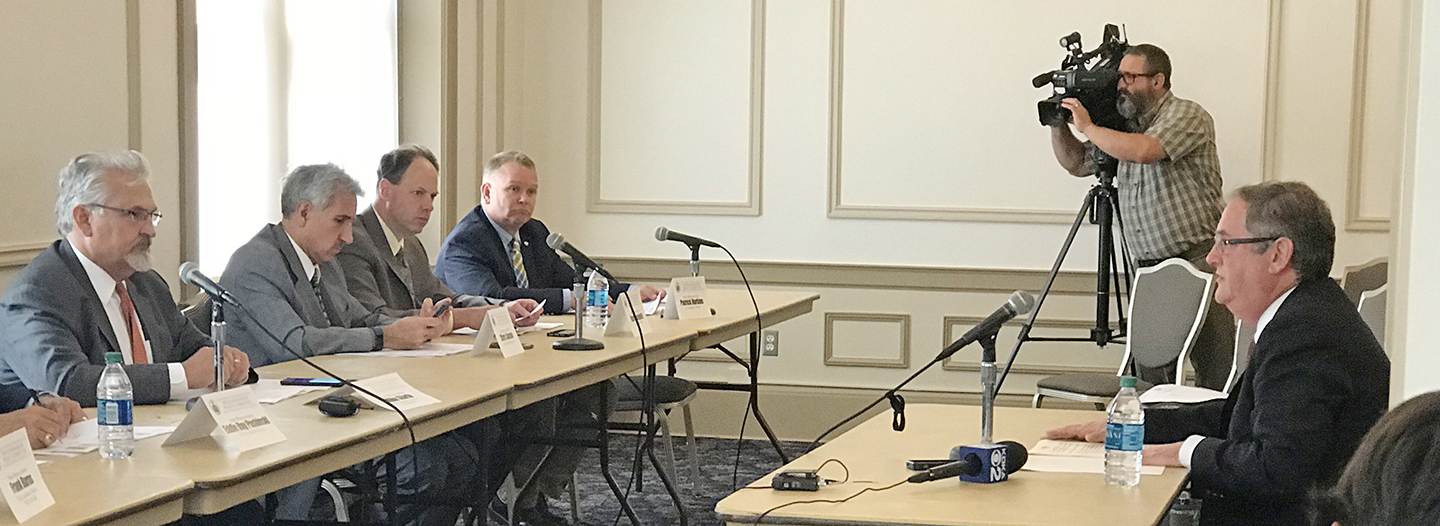
APSCUF President Dr. Kenneth M. Mash explains the importance of affordable higher education to the House Democratic Policy Committee July 18 at the University of Pittsburgh.
Testimony (as prepared) of Dr. Kenneth M. Mash
President, Association of Pennsylvania State College and University Faculties
Before the House Democratic Policy Committee
on “The Pennsylvania Promise”
Wednesday, July 18, 2018
University of Pittsburgh
William Pitt Union (Kurtzman Room, 1st Floor)
Chairman Sturla and members of the committee,
Thank you for the opportunity to testify today about this extremely important issue. My name is Dr. Kenneth M. Mash, and I am the president of the Association of Pennsylvania State College and University Faculties (APSCUF). APSCUF represents about 5,500 faculty and coaches who work at Pennsylvania’s state-owned universities.
My colleagues and I have had the opportunity to witness students speak about what a difference the Pennsylvania Promise would have made to their lives had it been available to them.
Jackie, a junior at Lock Haven shared this story:
We heard multiple stories like this one; they are all too typical of the students we meet in our classrooms. Students like Jackie have made extraordinary sacrifices to earn a college degree. They are practically superheroes.
Yet, I can’t help but to wonder how many students cannot do it? How many students must drop out because they can’t afford it or because they can’t maintain grades because their energies are expended on working multiple jobs? Why should they have to?
Even those students who manage to do face enormous debt when they are done. Mary, a graduate of Kutztown University, wrote to us that:
“The cost of attending college has left me in so much debt that I found myself taking a job outside of my field of study to pay my bills. I am unable to pay my full student loan payments, so I will be paying back more money in a longer period of time. In my senior year, my financial aid was cut so it wouldn’t cover my tuition, so the private loan I had to apply for to cover my rent went straight to the school, leaving me without money to pay for my housing. I moved out of that apartment two years ago, and I owe my landlord double of the rent because I had no way of paying him. I am stuck living at home because I cannot afford to be on my own, let alone my credit does not allow me to be approved for anything.”
I am often concerned that too many policy-makers incorrectly project their college experience on the students of today. There is just no comparison. When the Commonwealth subsidized two-thirds of the cost of college, it was possible to find part-time to help pay for most of it or to have some extra spending money in one’s pocket. Today when the Commonwealth pays less than 25 percent of the cost, students can work full time and still cross the graduation stage to face tens of thousands of dollars in debt.
I have often heard it said that, “not everyone should go to college.” Of course this is true. But everyone should have a fair opportunity to go if they meet the admission standards.
The universities comprising Pennsylvania’s State System of Higher Education have been and they continue to be the universities for working-class Pennsylvanians. A recent study by the Keystone Research Center and Pennsylvania Budget and Policy Center confirmed what many of us already understood to be true: “Because of the State System’s greater access for working families, its mobility rate — defined here as the share of all students who come from the bottom 60% of families AND then move into the top 40% of earners (total pre-tax individual earnings) as adults in their early thirties – is 22%, compared to just 14% for the top 10 elite private colleges.”
The most disturbing element of the study was that should the 2012 cohort be propelled up to the top 40 percent at the same rate as those who attended college between 1999 and 2004, the overall mobility rate will fall 12 percent, and that is due to a drop in the number of students from bottom 60 percent families who can afford to enroll at our universities — 41 percent in 2002, and 35 percent in 2013. (study, p. 9)
In 2013, Maguire Associates conducted a study for the State System. That study examined the potential impact of increased costs on enrollment at state-owned universities, and it concluded that an increase of more than $3,000 in total college costs (tuition, fees, room and board costs, etc.) would lead to drastic reductions in enrollment. Moreover, the effects would be felt the worst at the five most cost-sensitive universities: Cheyney University, Mansfield University, Clarion University, Edinboro University, and California University. It is not a coincidence that, years later, those five universities are the ones confronting difficulties. They are also universities serving communities that desperately need affordable, high-quality higher education.
While many hone in on tuition, for families who decide what college to attend or whether to attend college at all, the bottom line is the most important factor. What we know about total college costs is not good. According to a recent study, tuition and fees now account for nearly three quarters (73 percent) of educational costs at State System schools compared with half that level (37 percent) in 1983–84. Further, total costs adjusted for inflation have risen faster for students because of large increases in the costs of room and board, which have increased by 76 percent (a hike of $4,567 in 2016 dollars) since 2000 compared with 51 percent ($3,351) for tuition and fees. Total college costs have risen by almost $10,000 since 2000, from about $15,000 to about $25,000 per year, and they have gone from one-fifth of median family income to more than one-third (35 percent). The costs have exceeded the $3,000 benchmark identified by Maguire Associates.
It is impossible to discuss total college cost without discussing the State’s allocation. The reality is that even with this year’s 3.3 percent increase (and we do heartily thank you for that), the inflation-adjusted funding for the State System is more than 25 percent below the 2007–08 level and a third below its 2000–01 level. Further, when one looks at Gross State Product, funding for the State System today is only 42 percent of its 1983–84 level.
Pennsylvania ranks 47th out of the 50 states in per-student funding. Responding to the cuts during the Great Recession, our universities sought to survive by raising tuition and fees and increasing enrollment. However, that response was limited because the bubble in the number of high school graduates was soon to burst. The increases in college costs have meant that students and their families have had to confront increasing debt or the choice to not go to college at all.
Increasing student debt does not serve anyone. While there is a reasonable argument to be made that students should be invested in their own education, those arguments ought to be understood along with the realization that our economy is hurt when graduates are not making purchases or otherwise putting money into the economy, but are rather paying principal and interest to the banks. Further, it ignores the plain fact that public higher education is a public good that reaps benefits not just to the individual graduate, but also to the Commonwealth overall.
This is a real problem that reinforces the difficulties of families, particularly in struggling communities. The KRC/PBPC study found that the Commonwealth ranks 40th for the share of adults ages 25–64 with more than a high school degree. In more than half of Pennsylvania counties (35), this share is lower than any of the 50 states (i.e., lower than West Virginia’s 48.1 percent).
This pattern is likely to continue because of the low percentage of high school students who are seriously contemplating college — that is, the number of students and families who actually fill out FAFSA forms. The contrast between Pennsylvania at its northern tier and the southern tier of New York is particularly stark. New York’s counties show 5 to 25 percent more students filling out the forms. Because these numbers came before New York enacted its free-tuition plan, we might expect that this differential will increase.
Unless we are willing to concede that Pennsylvanians are less motivated or less intelligent than their northern neighbors — and we certainly are not — we must understand that something else is going on here, and that something is that college is increasingly not affordable.
Recently the State System’s vice chancellor said, “it turns out that our current pricing strategies are driving the very students that we were hoping to have access to a State System education out of a State System education.” The system said the biggest drop-off has been students with family incomes in the $48,000 to $75,000 range. This is where the Pennsylvania Promise proposal outlined in House Bill 2444 sponsored by Chairman Jim Roebuck (D- Philadelphia) and State System Alum Rep. Jordan Harris (D- Philadelphia) could greatly benefit our students.
House Bill 2444 outlines an ambitious proposal that stemmed out of the Keystone Research Center’s report titled “The Pennsylvania Promise: Making College Affordable and Securing Pennsylvania’s Economic Future.” This proposal would do the following:
- Cover up to four years of tuition and fees for a student at any of the Commonwealth’s 14 public community colleges. This would cover up to an associate degree with the four-year range covering those nontraditional students who may not be able to finish in two years
- Cover four years of tuition and fees for any recent high school graduate with a family income less than or equal to $110,000 per year and accepted into one of the 14 universities in Pennsylvania’s State System of Higher Education
- Cover four years of tuition and fees not to exceed the State System tuition rate for students with a family income less than or equal to $110,000 for students accepted into a state-related university
- For students who qualify, the Pennsylvania Promise would cover along with tuition and fees room and board for students with a family income less than or equal to $48,000 5. Finance a grant program for adults seeking in-demand skills and industry-recognized credentials, as well as college credit
The Pennsylvania Promise would be a game-changer for students and all citizens of the state. The Pennsylvania Promise would make college truly accessible, and it would free many students from a debt burden, allowing them to contribute to the economy more quickly by doing the things that previous generations could afford to do, like purchasing a car or a home.
The Pennsylvania Promise would help even students who did not qualify for grants. When more students attend a university, you have more students contributing to the fixed costs. Universities that saw enrollment gains could even afford to lower costs for all students.
In its 2018 “Best States” report, U.S. New and World Report ranked Pennsylvania 50th in higher education. No lawmaker or resident of Pennsylvania should be proud of this ranking. Something must be done, and the Pennsylvania Promise is the right thing to do.
Let’s fund Pennsylvania Promise through a severance tax
As I prepare to enter my junior year at Clarion University, my passion for funding higher education in the Commonwealth of Pennsylvania has never been higher. I believe we should invest in public higher education to reach a solution that works for students, faculty, and coaches. This begins with the Pennsylvania Promise.

John Danvers, APSCUF intern
In this piece, which originated as a research paper I wrote for my English class last year, I’ll also outline how Pennsylvania can make that promise happen.
Quite simply, the Pennsylvania Promise is “a plan to make higher education affordable in the Commonwealth.” For students coming from a family income of less than or equal to $110,000 per year, that student would have four years of tuition and fees covered at any one of the 14 State System schools. The Pennsylvania Promise would also cover tuition and fees at any community college in the Commonwealth, as well as four years of tuition and fees “not to exceed the State System tuition rate” at any state-related university.
PA Promise legislation is in the State House as HB 2444 and in the State Senate as Bill 1111. It provides a pathway for students who may not otherwise be considering college to attend school and achieve the American Dream. Whether that Pennsylvanian is from Pittsburgh or Philadelphia, it would allow those who need help the most to lift themselves out of poverty.
The economic benefits the Commonwealth receives from facilitating affordable higher education are tremendous. From a microeconomic perspective, Pew Research Center says, “the gap in median annual earnings between a worker with a high school diploma and one with a college degree is $19,550. According to a Pew Research analysis of census data, over the course of a forty-year working life, the typical college graduate earns an estimated $550,000 more than the typical high school graduate, even after factoring in the costs and foregone earnings associated with going to college.”
Also, I think it’s important to note the macroeconomic benefits reciprocated from funding higher education. Research published by Philip A. Trostel, an economics professor at the University of Maine, shows that “college education creates substantial state and local tax revenues. Each bachelor’s degree leads to roughly $55,600 in additional state income taxes over a lifetime. In present value using a 3% discount rate, bachelor’s degree holders pay, on average, 2.5 times as much state income tax as high school graduates without college.”
In translating this outlook for long-term government revenue flows, the government spends about $74,500 in aiding students as they pursue a bachelor’s degree. After graduation, college graduates put back $471,000 into the government budget once they become employed and begin paying taxes. As Trostel writes, this is “more than six times the gross government cost per college degree.”
The possibility of upward mobility, along with the aforementioned benefits of students attending college, would be an immense benefit to the Commonwealth and something I believe our legislators should seriously consider facilitating. How? It’s time to implement a severance tax to fund public higher education in Pennsylvania.
Pennsylvania is “the only major gas-producing state in the country without a severance tax,” according to NPR. Gov. Tom Wolf has asked the Commonwealth to tax the Marcellus Shale industry 6.5 percent for the value of its revenue, a policy projected to generate $217.8 million dollars for the state. So far, however, the policy has not been implemented.
A severance tax on the Marcellus Shale industry is the most rational way to make public higher education affordable for all Pennsylvanians.
—John Danvers,
APSCUF intern
APSCUF welcomes faculty intern from West Chester University
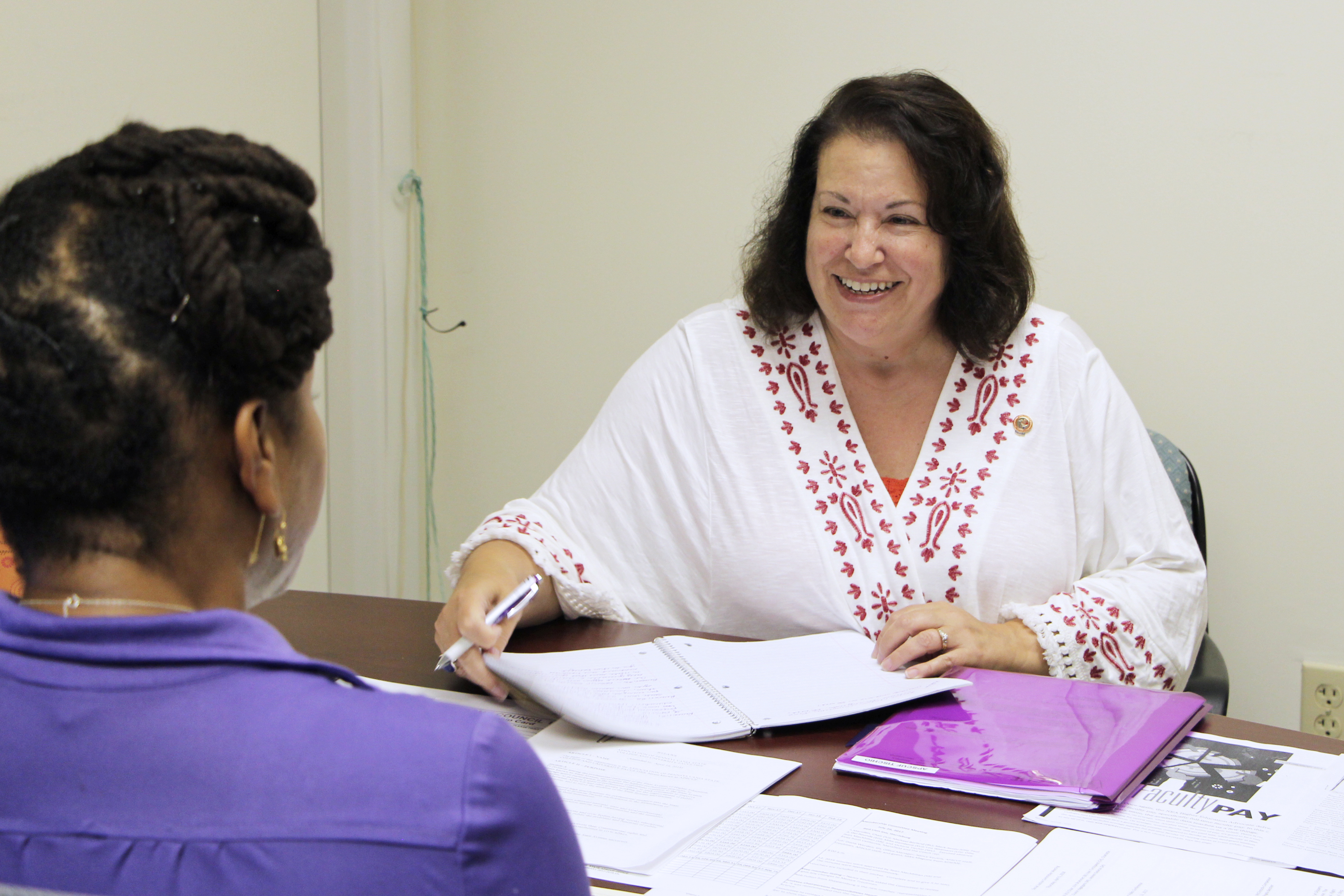
West Chester University Professor Victoria Tischio, right, discusses membership with Chabria Thomas, State APSCUF’s director of organizing, during Tischio’s APSCUF faculty internship in Harrisburg. Photo/Kathryn Morton
We are delighted to have West Chester University Professor Victoria Tischio as our faculty intern this week. She will be in the Harrisburg office interacting with staff members and observing the spectrum of union administration.