
Blog
Don’t discard your card
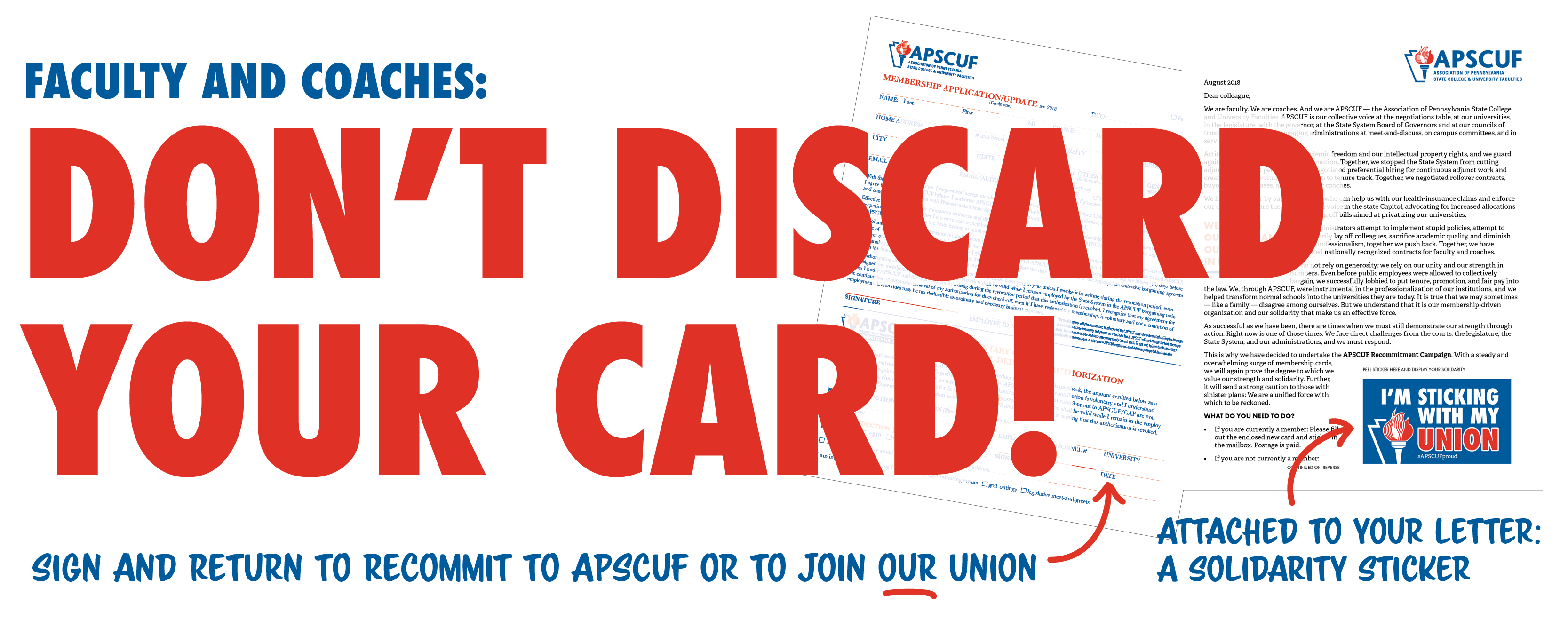
In late August, you should have received a recommitment letter and application from OUR faculty and coaches union, the Association of Pennsylvania State College and University Faculties. If you are already a member, your status hasn’t changed, but our goal is for all members — existing and new — to complete and mail back the postage-paid cards as a show of solidarity. If you accidentally disposed of the mailing (sent to your home address) or did not receive one, please contact your chapter APSCUF office to obtain a new card as soon as you’re able.
If you’ve already returned your card, thank you! We’d love to see photos of you signing your card (with your personal information indistinguishable, for safety purposes) or of your sticker in its new home. Email images to or tag APSCUF in your social-media posts.
Thank you!
Watch for APSCUF during SPORTSfever games this fall

Photo/Pixabay
APSCUF members will be featured and interviewed during televised football, soccer, and field hockey games this fall as part of APSCUF’s sponsorship of SPORTSfever.
This Saturday, Sept. 1, the college-sports network will interview Clarion University Athletic Director Wendy Snodgrass. Broadcasts also will feature an APSCUF commercial and the APSCUF logo.
SPORTSfever broadcasts
| Date | SPORTSfever broadcast | Time |
|---|---|---|
| Sept. 1 | Shippensburg at Clarion (Highmark Stadium) | 1 p.m. |
| Sept. 8 | No game | No game |
| Sept. 15 | Bloomsburg at Mercyhurst | 1 p.m. |
| Sept. 22 | No game | No game |
| Sept. 27 | East Stroudsburg at Millersville | 7 p.m. |
| Sept. 29 | West Chester at Edinboro women's soccer | 9:30 a.m. |
| Sept. 29 | Shippensburg at West Chester | noon |
| Sept. 29 | Gannon at Edinboro | 2 p.m. |
| Oct. 6 | Edinboro at Mercyhurst | noon |
| Oct. 6 | West Chester at Bloomsburg | 2 p.m. |
| Oct. 13 | East Stroudsburg at Bloomsburg | 2 p.m. |
| Oct. 20 | Shippensburg at Bloomsburg field hockey | 11 a.m. |
| Oct. 27 | Millersville at Bloomsburg | 3 p.m. |
| Nov. 3 | No game | No game |
| Nov. 10 | East Stroudsburg at Clarion | noon |
Where to watch
ESPN 3 (Accessible online to more than 86 million households at WatchESPN.com, on smartphones and tablets via the WatchESPN app and streamed on televisions through Amazon Fire TV and Fire TV Stick, Apple TV, Chromecast, Roku, Xbox 360 and Xbox One)
ESPN College Extra (Live TV available to AT&T Uverse, DirecTV, Bright House Networks, Cox, Time Warner Cable, Verizon FiOS and select NCTC subscribers)
Pittsburgh DMA (1.1 million HHs)
WPNT 22 The Point (22 over-the-air, Comcast SD 10/HD 812, Comcast Clarion SD 12/HD 812, Armstrong SD 22/HD 105, Atlantic Broadband SD 8/HD 707, Citizens SD 12/HD 812, Time Warner SD 22/HD 1022, Verizon SD 10/ HD 510, Consolidated SD 10/HD 710, DirecTV & Dish Network 22) Pittsburgh
Harrisburg-Lancaster-York DMA (614,000 HHs)
WHP 21.2 My Network (21.1 over-the-air, Comcast 19, Armstrong 15, Blue Ridge 133, Nittany 99, Verizon 21, DirecTV 22)
Johnstown-Altoona-State College DMA (207,000 HHs)
WJAC 6.2 Me TV (6.2 over-the-air, Comcast 110-187-202-248, Armstrong 410, Atlantic Broadband 110, Windstream 16, Laurel Highland 15)
Erie DMA (141,000 HHs)
Erie News Now ENN+ (35.3 over-the-air)
Delay 8 p.m. Saturday, Sept. 1
Cleveland, Erie, Youngstown, Columbus, Buffalo, Akron, Toledo, Charleston DMAs (2.6 million HHs)
SPORTS TIME OHIO (Erie Time Warner 21-23/HD308-1308, Armstrong 47/HD177, Sharon Time Warner 76/HD 308-1308, DirecTV 662, Dish Network 431)
Participate in SPORTSfever
Are you an APSCUF member interested in appearing in a SPORTSfever broadcast? Email .
Fall intern: “It is extremely important to support a union”

Hello, my name is Sydney Miller, and I am APSCUF’s government-relations and public-relations student intern for this fall semester. I am enrolled at Lock Haven University of Pennsylvania, where I am majoring in political science with a concentration in pre-law. After graduation, I hope to expand my knowledge in the education field while working with education policies and child advocacy. My career ambitions include working with early education policies and funding. I’d also like to run for public office. I hope to start my own nonprofit organization for children in local neighborhoods while working with the Victim’s Intervention Program.
I am excited to intern with APSCUF because higher education will open opportunities for me in the field I am so passionate about. It is extremely important to support a union that gives students a high-quality education with a price an American middle-class family can afford.
Finally, let me tell you a little more about myself. I am a part of the Pennsylvania Army National Guard as a signal support systems specialist. I am a proud member of Zeta Tau Alpha at Lock Haven University as well as a member of the cheerleading team. I enjoy playing the guitar and singing at local open-mic nights. I have one dog named William who is also my running buddy.
I cannot wait to get started!
—Sydney Miller, APSCUF intern
Be confident with an open mind, APSCUF intern advises after summer in Harrisburg
Deciding whether or not to apply for an internship can be a difficult decision. During the application process, one has many factors to consider: What will I learn, will the experience be worth it, is the internship paid or unpaid, and how much will it cost to live where I’ll be working? In this post, I’ll try to answer some of the frequently asked questions prospective interns have, while also giving a brief overview of my experience at APSCUF in Harrisburg this summer.

APSCUF intern John Danvers, center, with Clarion University’s ASPCUF Chapter President Ray Feroz, left, and Clarion Professor Kevan Yenerall at APSCUF’s legislative reception in June. Danvers is an economics and political-science major at Clarion.
The acknowledgements
Before I begin, however, I want to recognize those who made this experience possible. Dr. Kevan Yenerall, my internship adviser, has played an indispensable role in my development and growth as I study Pennsylvania politics. His commitment to students is unparalleled, and I am grateful to have him as my professor and adviser at Clarion University.
Here in Harrisburg, I’d also like to express my gratitude to a few individuals. Kathryn Morton and Sean Crampsie, my internship supervisors, are incredibly talented professionals and have served as tremendous mentors during my time with APSCUF. Kathryn is the consummate communications director, and Sean knows our state legislature inside and out. Finally, I’d like to thank Dr. Mash and the APSCUF staff for their kindness and willingness to help me whenever I had a question or need.
The details
Here’s what you need to know about the internship. First, if financing a summer in our state’s capital is a concern, don’t let this stop you from applying. APSCUF provided an apartment while also paying $11 an hour to work 35 hours each week. My only notable expenses were for groceries and parking.
Over the course of my 10 weeks in Harrisburg, I shadowed lobbyists, interviewed legislative assistants, and met state representatives and senators. Also, I gained valuable public-relations skills, such as learning how to write a column for a newsletter and interviewing an APSCUF member.
A normal day for me would entail waking up around 6 a.m., going for a run (I’m training for a marathon.), then heading to work around 7:45 (I parked about a mile away from the office.). The work day runs from 8:30 a.m. to 4:30 p.m. with an hour for lunch. After work ended, I’d usually go to the gym for an hour, come home and eat dinner, then go to bed and recharge for the following day. It sounds boring at first, but it’s a process I came to love and embrace.
My advice to anyone interested in this program is to have confidence in yourself but go into every situation with an open mind. Be ready to learn. Ask questions. That’s what this entire thing is about. Also, don’t be afraid to put yourself out there. Harrisburg is a microcosm of any major political environment — and in a way is one in and of itself. Talk to people, get their cards, and follow up. Lastly, have fun. South central Pennsylvania is in proximity to the major metropolitan areas of Philadelphia, Baltimore, Washington D.C., and New York City. I even went up for a weekend to visit some family in Connecticut. Take advantage of this great opportunity to do some exploring and make your friends jealous while they sit by the pool all summer. Good luck!
—John Danvers, APSCUF intern
As fall expenses loom, student shares ways to save

Photo/Pexels.com
APSCUF believes quality, affordable higher education should be available to everyone in Pennsylvania. By supporting endeavors such as the Pennsylvania Promise, we’re working for students as well as the faculty and coaches we represent. With college affordability and the upcoming fall semester in mind, we collected links to help students on the financial and academic fronts. And because college life doesn’t just encompass studying in the library for endless hours, we’ve included resources for staying healthy and eating right — both part of a successful college career.
Finances
- Interested in seeing whether you qualify for money that can be applied toward college? Use this link to fill out your Free Application for Federal Student Aid form. FAFSA awards qualifying students with financial packages such as Pell Grants, Stafford Loans, Federal Perkins Loans, and can help you set up a work-study program. The lower your household income, the more you potentially qualify for in financial aid.
- You can end up spending up to double or triple at a college bookstore than you would buying textbooks online. Always price-check books on websites such as Chegg and Amazon, both of which offer special prices for students.
- Click here to read Forbes’ 10 best money tips for college freshmen.
- Don’t let your friends make you think couponing is lame. In fact, you can save a ton of money by doing it. Check out websites like The Krazy Coupon Lady and Passion for Savings to start saving money today.
Food
- Cafeteria food might not be the greatest, but it certainly can help save you money in the long run. Always price-check a meal plan at your university before going out to Subway or Pizza Hut every night.
- Dr. Michael Martin, associate professor of English at Bloomsburg University, developed a student-powered website titled “Healthy Husky,” where students can check out ways to prepare healthier foods, sleep better, and learn about holistic wellness. You can check it out here.
Academics
- School can be hectic — no doubt about it. Always make sure you’re prepared for class, homework, and exams. Online and mobile organizers, such as My Study Life, can help you plan for success.
- Curious as to what your GPA is but don’t have a transcript on hand? Use this free GPA calculator to see where you stand on that quest to graduation.
Health and fitness
- 7.3 percent of college students have seriously considered attempting suicide in the past 12 months, according to American College Health Association’s National College Health Assessment. If you or someone you know is having suicidal thoughts, please call the National Suicide Prevention Lifeline at 1-800-273-8255.
- It’s important to maintain cardiovascular and physical strength, too. Check out this article from U.S. News for advice on staying in shape while at college.
- Running can be a great way to get in shape and meet new people. Ever thought about running a 5K? Check out this cool training plan designed by Nike to get you across the finish line.
- Yoga can also be an excellent way to relieve stress and strengthen your body. To find out how to release your inner yogi, watch Yoga With Adriene on You Tube.
Free activities
- Volunteer at your local animal shelter or for any other cause that you’re passionate about. For more information, visit Volunteer Match.
- Try geocaching. Check out this link to learn more about “the world’s largest treasure hunt.”
- Explore your college town and learn about the area’s culture and history.
- Have a movie marathon by borrowing some free films from the library in your town.
- Check out a good book from your university’s library or your local community library.
—John Danvers, APSCUF intern