
Blog
Campus Equity Week: We can do better
Campus Equity Week is about acknowledging the great nationwide divide that exists between higher-education faculties. The reality is what Marc Bousquet notes in “How the University Works”: “In thirty years of managed higher education, the typical faculty member has become a female nontenurable part-timer earning a few thousand dollars a year without health benefits.” What’s more, Campus Equity Week is an opportunity for us all to advocate, to agitate, to act.
 Action is where many of my fellow tenure-line faculty and I have sometimes fallen short. We sympathize with our temporary colleagues when we see so many of them pooled in one office, perhaps sharing a single computer. We shake our heads in disapproval when an administration delays approval for hire or renewal, giving adjuncts little time to prepare for classes. We wonder at those in our department who have worked alongside us for 10 years without a single step-raise. We feel bad, but we too often also feel powerless to effect any lasting change.
That has not always been so. In my 11 years at Kutztown, I’ve seen APSCUF and our faculty stand up twice to face State System proposals that would significantly hurt our temporary colleagues. During the 2016 strike, APSCUF members rejected a temporary faculty workload increase without an increase in pay. During the previous round of contract negotiations, many tenure-line and contingent faculty successfully protested a similarly ugly scheme. In those times of crisis, we stood up together. I was never so proud to be a part of this community.
That’s why I’m addressing this post to my fellow tenure-line faculty. We’ve done well, and I know we can do better. In between crises, many of us allow the working conditions and treatment of temporary faculty to become background noise, someone else’s issue, something for “the union” to deal with — forgetting that we are the union. The fight for campus equity belongs to all of us, all the time.
The first chapter of Bousquet’s book is titled “Your Problem is My Problem,” yet he concludes that tenure-line faculty have not developed “anything that resembles an oppositional culture” in the face of austerity and the adjunctification of higher education. Nine years after his book’s publication, I have more optimism than he, in part because I’ve seen so many tenure-line faculty step up in the Pennsylvania system. At the same time, I’d like to see us be more proactive in our fight for equity, not just reactive to harmful, neoliberal contract proposals. We might make additional demands regarding contingent faculty in negotiations and to our administrations: for step increases, longer-term contracts, and more equitable professional-development support. State and chapter APSCUF leadership needs to see the support of faculty — all faculty — behind them. It requires that tenured profs recognize that their problem is our problem, that their fight is our fight.
Consider the long-term effects that increased adjunctification can have on departmental culture and health, on students’ access to professors, on shared governance. As the number of tenure-line faculty shrink, so does the number of us in protected positions from which to advocate for fair labor practices. Fewer of us can tackle the ever-expanding service components of the job. We become what Nancy Welch calls “angels in the architecture” of higher ed, forced to do more and more with less and less. If we protect tenured privileges while allowing the number of adjuncts to grow and their conditions to worsen, we allow the university to decline through attrition.
Campus Equity Week reminds us that we are indeed empowered to act. We can effect change in our immediate environments, between contract negotiations. We can ask the temporary faculty in our department what professional concerns they have and really listen. We can acknowledge the professional and disciplinary insights that they bring to our classrooms, committees, and campus communities — and follow up by insisting that our departments reflect this in their practices and policies. We can advocate that departmental and campus professional-development funds be extended to adjuncts or increased to reflect the high costs of conferences and workshops. We can insist that our chairs consider the scheduling needs of and number of preps allotted to temporary faculty with the same respect given to tenure-line faculty. Equity is gained not just in strikes, but in the small challenges we choose to face every day.
We’ve done well. Now let’s do better.
Amy Lynch-Biniek is an associate professor of composition and rhetoric at Kutztown University. A former adjunct, she is chair of the statewide adjunct committee of the Association of Pennsylvania State College and University Faculties.
Chapters plan Campus Equity Week events to promote faculty fairness
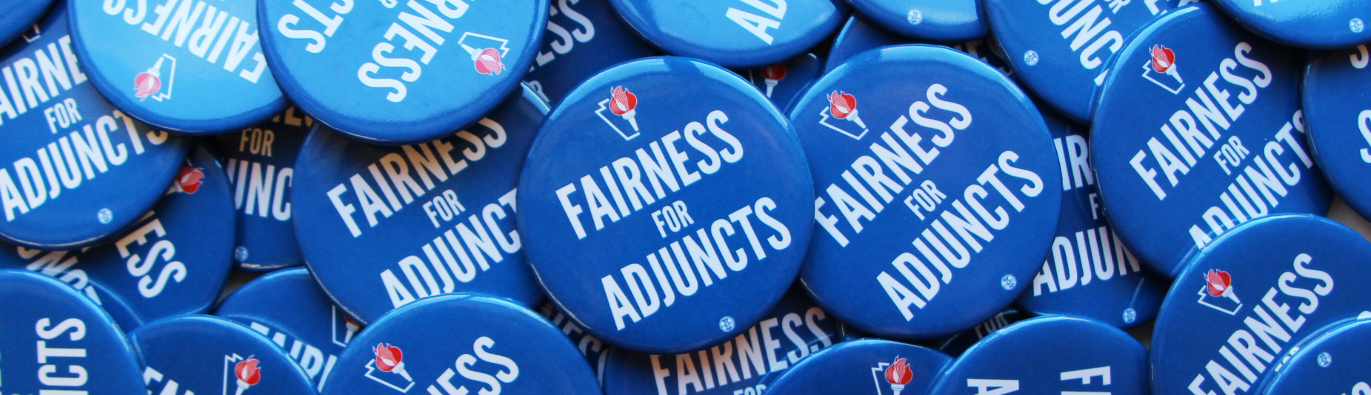
Campus Equity Week is a national movement dedicated to promoting fairness to faculty and raising awareness of the situation that adjunct faculty face nationally. CEW begins today with a day of action planned for Tuesday, Oct. 31, and APSCUF is bringing the movement to our campuses.
Adjunct faculty members nationwide are not paid a livable wage and worry about job security, which can have a negative impact on the quality of higher education, according to research by The Delphi Project and the Center for the Future of Higher Education. CEW is helping to raise awareness for APSCUF’s adjunct faculty, as well as the more than 800,000 adjunct faculty nationwide that these issues affect.
Locally, Kutztown University APSCUF has events planned for Monday, Oct. 30, to help advocate for fairness to faculty. Stop by MSU 250, the Presidents’ Room, to pick up a “Fairness for Adjuncts” button, get more information from displays and documentaries, and join discussions to learn how to advocate for fairness on campus.
West Chester University APSCUF is hosting an adjunct Halloween event 11 a.m. to 1 p.m. Tuesday, Oct. 31, at Sykes Union Room 255. Come for snacks, beverages, and opportunities to meet with fellow adjuncts and APSCUF members. Discuss issues that are important to you so APSCUF can make sure your voice is heard.
At Lock Haven University last week, APSCUF showed “Con Job: Stories of Adjunct and Contingent Labor,” followed by a panel discussion. The award-winning short documentary features Seth Kahn, West Chester University professor.
For more information about Campus Equity Week, click here. For information about CEW activities on your campus, contact your chapter adjunct or mobilization committee chairperson.
—Brendan Leahy
APSCUF intern
APSCUF welcomes new government-relations director
This week APSCUF welcomes Sean Crampsie, our new government-relations director, to the State APSCUF office.

I am pleased to join APSCUF after nearly four years with the Pennsylvania School Boards Association working in government affairs. During my time at PSBA, I promoted a pro-public education agenda in Harrisburg on behalf of the 4,500 locally elected school directors.
I am a proud graduate of Bloomsburg University, where I earned a bachelor of arts in political science. After college, I went from volunteering on political campaigns to political field director for a Lehigh Valley congressional campaign that drew national attention.
I was elected to Carlisle Borough Council in 2015 and took office in January 2016. I live in Carlisle with my wife, Brittany.
I look forward to working with all of you in the future, and we will keep you updated on important legislative issues in Harrisburg.
—Sean Crampsie
government-relations director
Read Dr. Kenneth M. Mash’s remarks to the Board of Governors – Oct. 19, 2017
APSCUF President Dr. Kenneth M. Mash’s comments as prepared:
Chairwoman Shapira, Chancellor Whitney, governors, and presidents,
On behalf of my faculty colleagues in APSCUF, the Association of Pennsylvania State College and University Faculties, I want to thank you for engaging in a smooth process that resulted in the one-year contract.
We appreciate the leadership of the chancellor and the board in this regard, and we are glad that our faculty members can, for at least one more year, concentrate without a major distraction their attention on the students and on making our universities the best institutions they can be.
We are also glad that we can focus our organizational efforts on support for our institutions.
Our students are far better off when we cooperate than when we are in battle. We further appreciate what Chancellor Whitney has been saying on our campuses about working together and seriously listening to concerns.
We hope that this is the dawn of a new day where the Office of the Chancellor models behavior that is expected on all of our campuses.
We do have campuses that are led by presidents who truly listen, who demonstrate in word and deed their respect for their faculty colleagues and all of those who work at their universities.
Our hope is that within the System that they are held up as examples of how academic institutions ought to be led.
Not that there is never disagreement, not that there are not hard choices to be made with which we will strongly disagree, but that decisions are duly informed and can be rationally explained to campus constituencies.
Bosses that solely rely on the power of their office rarely find success in any enterprise; with academic leadership, it is a recipe for disaster.
For our System to thrive, we need to stop some of the pettiness that occurs on our campuses. The campus climate ought to be an important factor in weighing the job performance of the campus leadership, and there need to be outlets within the System that faculty, coaches, students, and all employees can turn to and know that their campus concerns are taken seriously.
We would hope that when a campus leader is consistently acrid in word and deed with respect to those who are responsible for carrying out the very mission of the State System that this would be a serious matter of concern for the leadership of the System.
We need to find a better equilibrium, particularly in the world of academic affairs, but also in the world of budgeting and administration. We believe that the State System ought to model that behavior, and that it should be insisted upon for our campuses. The sense we get is that the System is moving in that direction, and we would like you to know that we appreciate it.
There is a far greater role for true input into the operations of our System, and I look forward to having the opportunity to articulate our perspectives in direct conversation with the System’s leadership.
We are fully aware of the challenges that face the System, and we look forward to confronting those challenges together in the most constructive ways possible.
Thank you very much for your attention.
Joyous news: We have a tentative faculty agreement!
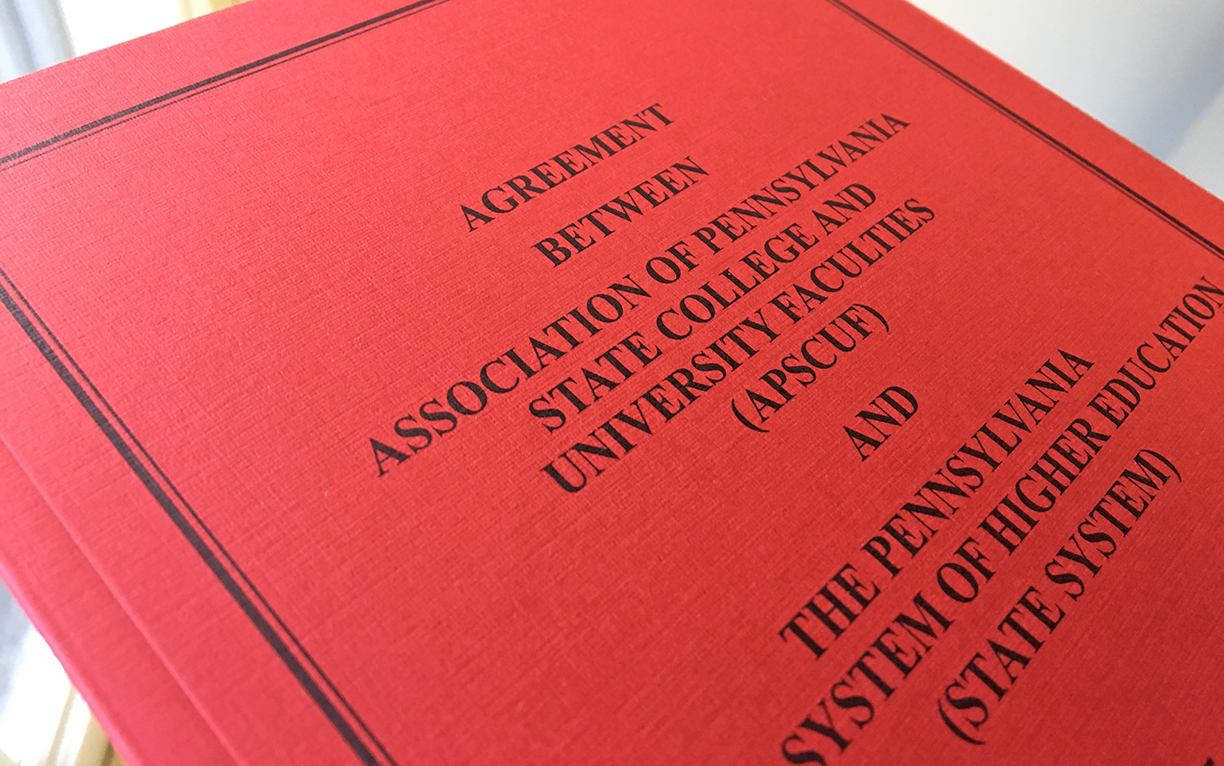
It warrants an exclamation point: The Association of Pennsylvania State College and University Faculties and Pennsylvania’s State System of Higher Education have tentatively agreed to a new contract that would run through June 30, 2019. Click here to read today’s joint release.
On-campus voting dates have not yet been set, and only full APSCUF members may vote on the tentative agreement. Prior to voting, full members will have an opportunity to view the tentative agreement in a secure, members-only area of the APSCUF website. Click here to learn how to become a member. If you’re already a member but not registered to view members-only areas of this website, click here to register.