
Blog
APSCUF president addresses possible faculty layoffs at Cal U
Several months ago, California University of Pennsylvania informed the Association of Pennsylvania State College and University Faculties that faculty layoffs were possible at the start of the 2017-18 academic year. Even after several meetings during which APSCUF requested information and sought alternatives, the leaders at California University plan to move forward with layoffs. Click here to read APSCUF President Dr. Kenneth M. Mash’s statement.
APSCUF life: Extracurricular opportunities
This summer, APSCUF is going behind the scenes to show how faculty members and coaches continue to devote themselves to affordable, quality education even when class is not in session.
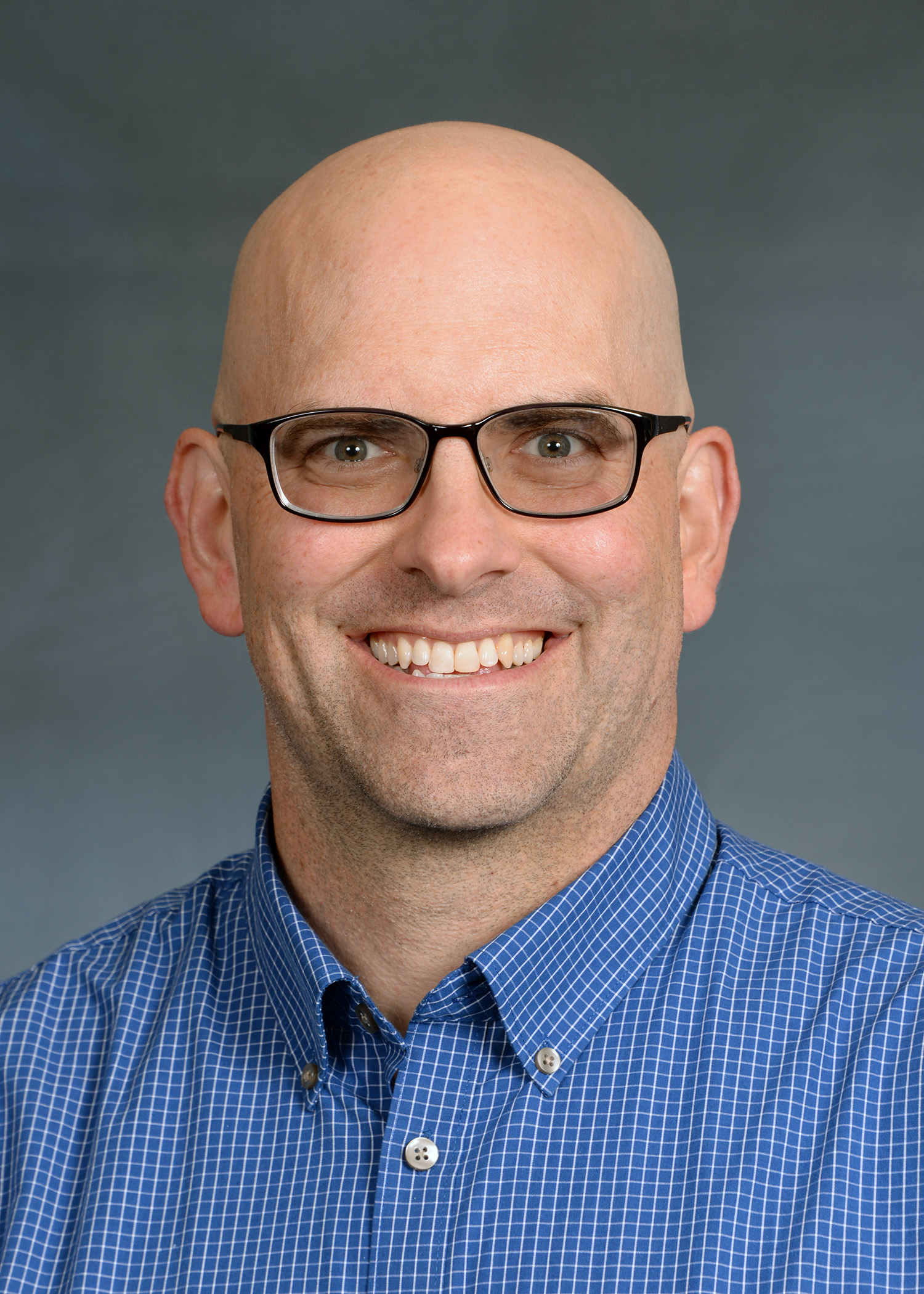
During my interview for my current position at Shippensburg University in 2005, the search-committee chair explained that many of my responsibilities would center on communicating between the College of Arts and Sciences and the College of Education and Human Services. Although I am officially housed in the Department of Chemistry, I am also responsible for teaching senior-level pedagogy courses for pre-service secondary science teachers and supervising student teachers in classrooms throughout central Pennsylvania. As anyone familiar with academia will attest, crossing the boundaries between different colleges on a university campus is certainly a challenge.
I, however, have come to enjoy this aspect of my work, even though it necessitates my attending more than the usual number of meetings, serving on more than the usual number of task forces, and writing more than the usual number of reports. With my serving as chair of the Department of Chemistry for the past five years, my extracurricular responsibilities have greatly increased. In the past year, for example, I have written accreditation reports for the American Chemical Society and the National Science Teachers Association. I also wrote our mandatory, five-year departmental review and arranged for two external consultants who were impressed with what our department accomplished with respect to teaching and undergraduate research with minimal time allocated in our workload and with basic resources. This is all in addition to lesson preparation, classroom instruction, office hours, and the standard slate of department chair responsibilities. The latter have grown as faculty positions are cut and administrative positions are created. Few, if any, of us have “summers off.”
Of course, routine tasks can be tiresome, and they sometimes seem to offer no tangible benefit. Much of this, however, recedes into relative insignificance since I am able to have such a diverse and rich career serving future chemists, science teachers, regional schools, and departmental and university colleagues. I am able to make professional contributions via publications and conference presentations in chemical education and science-teacher education. I’ve also had the opportunity to develop a STEM-specific Master of Arts in Teaching (MAT) program for second-career teachers, and Shippensburg University is being considered as one of the partner institutions for the Woodrow Wilson National Teaching Fellowship program. The chemistry department also hosts an elementary chemistry day camp each summer that just celebrated its 10th anniversary. We still hear from students years later about how this outreach effort positively impacted their lives.
Although it was something I’ve never intended on doing, I took my interest in the historical interactions between science and religion and developed a course for our honors program as well as in-demand outreach to churches in the region. This has enabled me to be one of the “go to” people in science-teacher education for how to prepare teachers to present concepts with religious implications.
I am grateful to Shippensburg for all of these opportunities to teach and serve. In particular, I deeply respect the work that our APSCUF colleagues do to preserve our multiple roles as teachers, scholars, mentors, grassroots university leaders and reformers, and community liaisons. Our jobs extend far beyond the basic classroom and office-hours requirements.
Joseph W. Shane is an associate professor of chemistry and science education at Shippensburg University.
Why an APSCUF internship is for you
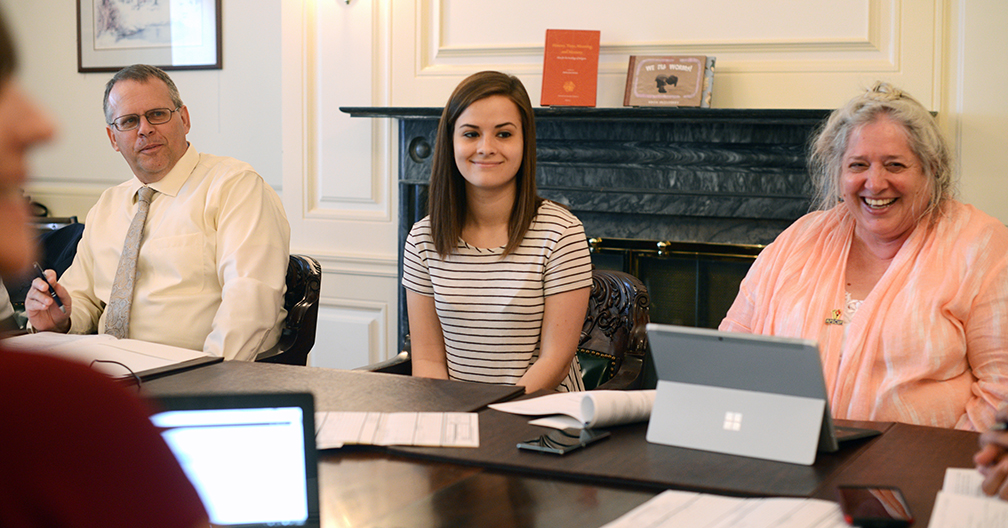
Mansfield University student Corrinne Rebuck, center, listens to the communications presentation at APSCUF’s July executive council meeting. Rebuck worked in the state office this summer, and today is the final day of her communications and government-relations internship with the union. Click here to learn more about future APSCUF internships.
I originally applied for the APSCUF internship out of curiosity about how unions operate and are involved in politics. I soon discovered I would receive much more out of this internship than I originally anticipated.
From writing blog posts to experiencing the political process in the Capitol, I quickly realized I had a lot to learn and that this internship was going to provide me with the experiences I desired.
One of the first things I learned was the impact politics have on APSCUF’s interests and issues. Making sure I was up-to-date on news and legislation was one of my favorite tasks during my internship, especially since I was a few minutes away from the Capitol.
Communication experience was another large element of this internship, and I had the opportunity to be highly involved in multiple communication projects. I was especially excited to participate in these projects because they were a great way to get to know some of the faculty members across the State System. Through these projects, I learned how valuable good communication skills are in the professional field and that there is always room for improvement.
The associate director of communications was excellent in distributing critical feedback on the work I submitted and providing me with multiple opportunities to put my newly acquired skills into practice. I wrote several blog posts, assisted in newsletter releases, and proofread multiple documents for the organization.
You may still be wondering why an APSCUF internship is for you. I can assure you this experience provided me with several networking opportunities where I could further figure out the career direction I wanted to pursue. Many of the professionals I met are alumni from the State System schools, so I was able to network with several individuals who had similar backgrounds as mine.
When you intern for APSCUF, you will be treated as a regular staff member, not an intern. From Day 1, I felt like part of the staff, and I was included in almost anything the staff thought beneficial for me. The staff is also more than welcoming of new ideas and shows a continued willingness to answer a multitude of questions.
As a student, this internship is a great way to have an inside look into what makes our universities work — the faculty and coaches. Having a union to support these influential people in our lives is vital, as many of the issues they face run parallel to our educational experience.
I would not have realized how important APSCUF is to our universities had it not been for this internship. Experiencing the political process, learning excellent communication skills, and gaining an inside look into our faculty’s union are just a few of the beneficial elements you will gain from this internship. My time at APSCUF has certainly been beneficial for my future career endeavors.
Corrinne Rebuck is entering her senior year at Mansfield University, where she majors in human resources and political science.
Letter from an APSCUF Student Intern
Need inspiration for your letter to Chancellor Frank Brogan? Here’s what APSCUF’s summer intern wrote:
Aug. 12, 2016
Office of the Chancellor
Dixon University Center
2986 North Second St.
Harrisburg, PA 17110
Dear Chancellor Frank T. Brogan,
My name is Corrinne Rebuck, and I am getting ready to enter my senior year at Mansfield University this fall. I have an older sister who attended Bloomsburg University a few years ago, so my family is a proud supporter of the State System. After hearing the many benefits of choosing a State System school from my sister, I naturally gravitated toward these institutions.
As a graduate from a small high school, I was especially inexperienced in the college scene. From Day 1, my professors at Mansfield made me feel that I belonged there, and that nothing was out of my reach as a student.
Although my time at Mansfield has been exceptional in multiple ways, I cannot help but compare my experiences to that of my sister’s. My sister majored in psychology at Bloomsburg and spoke volumes of a neuropsychology course she had the opportunity of taking. Being a psychology major myself, I, too, wanted to add this class to my educational experience. I asked my adviser, and he said that although the course had been offered a few years ago, it had to be cut since Mansfield no longer had the proper faculty member to teach the course.
Unfortunately, this is not the only situation I have witnessed in my time at Mansfield where I began to question the quality of the institution, simply because there never seemed to be enough faculty members. I often witness my professors being stretched in multiple directions to make our educational experience the best it can be within their ability. Courses needed to graduate are often filled to their capacity since hiring more faculty members is unlikely under current circumstances. I see faculty work significantly harder to do more with less in an effort to give their students all that they can — often beyond the limits of what a single person should be doing.
Being only one student who witnesses one department’s struggles, I can guarantee I’m not alone in my observations. I ask that you seriously negotiate a fair contract for my faculty members, especially since students are the direct beneficiary of their position and are with them every day on campus.
I will always remember my professors and their ability to go above and beyond for me and their other students. Unfortunately, I will also remember their struggle to attain the fair contract they rightfully deserve.
Please keep the faculty members across the State System in mind as the negotiation process continues, so other students can give credit where credit is due and continue to be proud supporters of the State System.
Respectfully,
Corrinne Rebuck
Contract update: Two-day negotiations session concludes
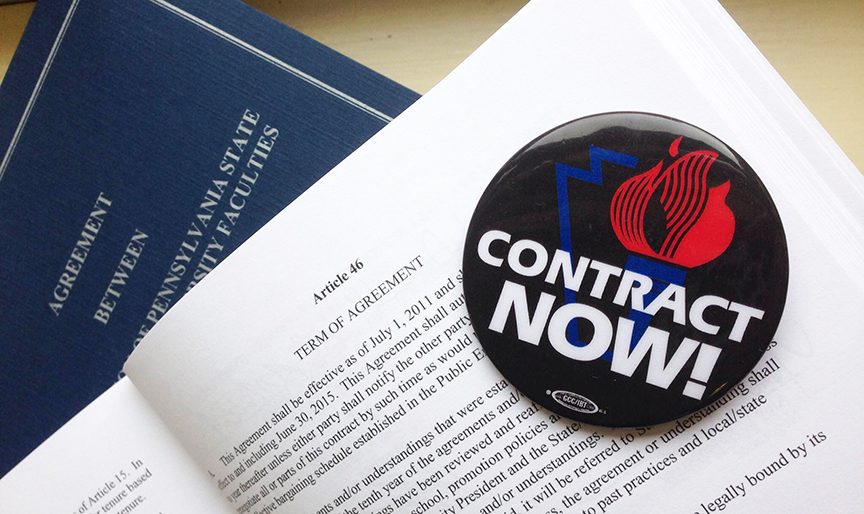
Negotiators for APSCUF and the State System met Aug. 9–10. Click here to read today’s press release.
The next faculty negotiations session is scheduled for Aug. 25–26. The next coach session is slated for Sept. 19.
Members, click here to sign up for text-message alerts about future contract news.