
Blog
APSCUF life: Summers are not ‘off’
This summer, APSCUF is going behind the scenes to show how faculty members and coaches continue to devote themselves to affordable, quality education even when class is not in session.

Like everyone, I look forward to summer: the good weather, some time spent in nature, and a chance to sit around the firepit in the evenings. However, my summers are not “off,” as many people might assume. Summer is the time to amp up the research agenda, prep for fall classes, complete administrative projects, and finish writing projects that develop out of conference experiences. What follows is an abbreviated list of my summer workload, divided into projects:
SURE research: This summer, one of my students was awarded a SURE grant: a Summer Undergraduate Research Experience. As a writing fellow, she works with my writing students and supports their progress over the course of the semester. We are co-authoring an article describing the writing fellow program at Shippensburg University.
First-year writing director: As the director of first-year writing at Ship, I develop programming that supports writing instruction and tutoring. This summer, I am working with an intern who is developing new publicity materials for the tutoring center and the writing program. Thus far, she has developed a brochure, a bookmark, posters, and a newly revamped Facebook page for our writing lab. I also train writing faculty and develop programming for students. I will host a training retreat for faculty in mid-August.
Writing placement: As first-year writing director, I am also responsible for running Writing Placement over the summer. In the spring, I recruit and train the Placement readers, and we begin reading and placing students by March. I continue to organize and facilitate placement all through the summer. I train orientation faculty advisers and help the administration determine the correct number of developmental writing courses.
Research/writing projects: I attended a writing conference in October, and I developed a writing project with my colleagues. We have been working on our article since then, but we made the most progress once the semester ended in May. I spent a week at a writing bootcamp at the beginning of May that helped kick-start my research and writing. I spent a full week writing, submitted the article, and heard in July that it was accepted. I also co-edit the academic journal Proteus: A Journal of Ideas, and I am writing the editor’s introduction to the latest issue.
Service-learning and teaching: My writing courses are designed as service-learning courses; most assignments ask students to learn more about a community issue and then write for or with a community member. To create more effective and meaningful assignments, I joined a local nonprofit, the Shippensburg Community Resource Coalition, and helped to develop projects that would benefit the community, such as the Shippensburg Summer Lunch Program and the pilot of the Big Brothers, Big Sisters program in Shippensburg. These projects provide my students with hands-on research and writing experiences.
President of the English Association of Pennsylvania State Universities: During the Spring 2016 semester, I was voted in as president of EAPSU, the English association that links all 14 sister schools in the State System. This summer, we are revamping our website and creating a new, more professional online presence. We are also rebranding our journal, soliciting new reviewers and essays, and advertising our fall conference.
Hiring faculty: Several of my colleagues have retired in recent years, but our department has not been given tenure-track lines to replace these faculty. We have searches to replace these faculty on a year-by-year basis, and I attend the teaching demonstrations and meet the candidates over dinner or lunch.
Training new writing fellows: Once we determine how many developmental classes we will offer in the fall, I will work with the director of The Writing Studio to recruit, hire, and train writing fellows. Once they are hired, I will meet with my fellow once a week during the semester as we both work to support my writing students.
Prepping for fall semester: During the summer, I research new textbooks and revise my syllabi for the coming semester.
Preparing for Welcome Week: I am co-chair of the service-learning portion of Welcome Week. With my colleagues, I will help choose and develop service projects for incoming students, and I run a service project of my own the Saturday before the semester starts.
Laurie Cella is an associate professor of English at Shippensburg University.
APSCUF life: Making history in and out of the classroom
This summer, APSCUF is going behind the scenes to show how faculty members and coaches continue to devote themselves to affordable, quality education even when class is not in session.
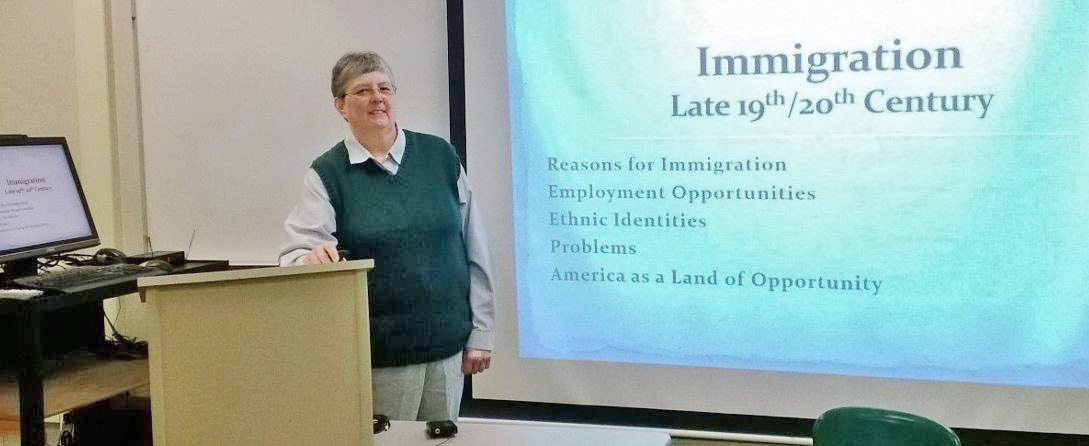
Karen Guenther produces lecture videos of her history classes at Mansfield University.
I began my career at Mansfield University as a tenure-track assistant professor of history in August 1998 after several years working in the private sector as a corporate trainer and supervisor and as an adjunct at several colleges. I quickly realized that being a college professor indeed meant more than teaching four classes a semester and holding office hours. At a small public liberal arts university such as Mansfield, it is very easy to become overwhelmed with the opportunities available for service, particularly membership on Senate committees, department committees, and the local chapter of APSCUF. Knowing that in order to be promoted from assistant professor to associate professor and now full professor I had to meet (and later, exceed) standards for promotion meant that while I was busy preparing new courses and grading student work, I also was expected to be an active scholar and serve the department, university, and community.
A lot has changed since Fall 1998. For example, I performed content visits of social studies student teachers my first semester (the secondary teaching certificate I earned as an undergraduate proved to be a valuable credential) to ensure that they taught accurate information; now I supervise student teachers and have prepared the accreditation reports for the social studies education program. Back then, technology in the classroom consisted of a VCR (if I was lucky) and an overhead projector; now I film my classes and produce lecture videos to help students prepare for exams and other assignments and to make my online courses as identical to a traditional face-to-face course as possible. My syllabi were just a couple of pages long, listing the required books, due dates, and assignments. Now they are monstrosities that not only include information related to how students can succeed in the course but also include Title IX information, U.S. copyright restrictions, and the dreaded student learning outcomes. I merely expected to teach my classes, spend time doing research, and join a few committees. Obviously, that didn’t work out too well.
Every semester, I am required to complete a faculty workload form. I estimate how many hours per week I will be involved in teaching, research, and service — but it’s only an estimate. If I actually punched a time clock like I did at previous jobs, it would be around 60–70 hours per week between teaching, office hours, grading, course preparation, film production, committee work, and research (and I’m sure I’m forgetting something). But I know as a professor that I don’t punch a time clock, although sometimes the temptation to punch something does occur.
Next fall, I will be required to be on campus five days a week, teaching four courses (with four different preparations) while also working a quarter of the time as academic programs assessment coordinator. One of the classes will include a group of students completing the degree requirement as individualized instructions prior to student teaching. I will be chair of the academic planning committee, the local Senate committee that reviews program changes for academic programs, and as such will be a member of the Senate executive committee and be expected to attend University Senate meetings. I also will chair the university sabbatical committee in the fall, along with leading the general education assessment team (one of my assessment duties). My schedule will require me to be on campus from 8:30 a.m. to at least 5 p.m., possibly later, many days because of class and meetings — and sometimes I eat lunch during meetings (skipping meals is not an option for medical reasons). In my spare time (!), I will continue to work on a research project that literally has been taking up a corner of my living room for the past five years, along with being Business Secretary of the Pennsylvania Historical Association.
I do think of myself as extremely lucky, because I get to do what I love (teach and research) and get paid to do it. I’m doing what I wanted to do 30+ years ago — teach at a small public university that values teaching — while at the same time having fun while working on assorted research projects. Faculty members like me are not just teaching content, but we are teaching our students valuable skills that will help them succeed in the changing world.
Karen Guenther is a professor of history at Mansfield University of Pennsylvania.
Contract update: Negotiators discuss distance education, but no major progress on contract
Negotiators for APSCUF and the State System met July 19. Click here to read today’s press release.
The next faculty negotiations session is scheduled for Aug. 2. The next coach session is slated for July 26.
Members, click here to sign up for text-message alerts about future contract news.
APSCUF members are resolute and strong
Our guest post today is by Dr. Seth Kahn of West Chester University.
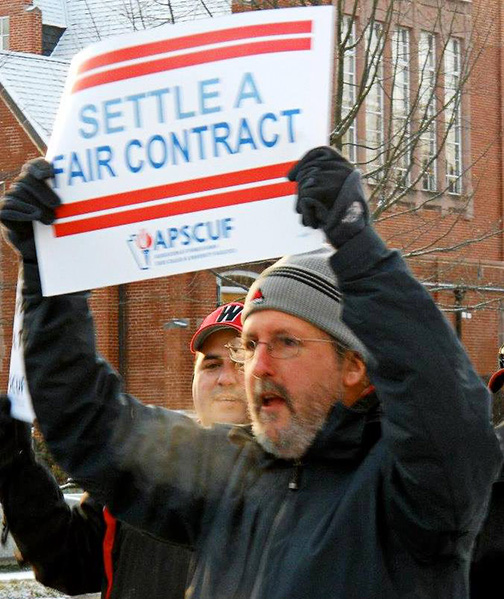
I had lunch the other day with a junior colleague on my campus during which we started discussing the current negotiations situation and what might happen in the event of a strike. At some point, she told me pretty plainly that she, and other people she’s friends with who are in their first few years, haven’t been reading the updates and newsletters coming from State APSCUF very carefully because the faculty have reached a point of saturation with the tone they hear coming from those of us in leadership positions (or who are just outspoken) over the last few years. The person I was with is strongly supportive of the union, but the way she put it, the people she’s talked to about the union have simply gotten to the point where they’ve shut down when they hear the “harsh” (her word) tone we often use in our communications.
Of course, my immediate reaction was to claim (and yes, I believe it) that the intention isn’t to sound that way at all, particularly in relation to the current negotiations, but instead to sound resolute and strong. I made that case, briefly, and it wasn’t entirely unsuccessful. But the conversation that followed made me realize three things. First, it doesn’t really matter what we intend if that’s not what you’re hearing. Second, what anger we do voice is often the result of years of managerial and political inattention to the realities of the system (as President Mash’s remarks to the Board of Governors from July 14 lay out). Third (and I never would have figured this out without my colleague’s conversation, especially for people who have only been in the system for a couple of years), the angst has been pretty relentless and has come to sound all the same — even when it isn’t.
It’s that third point I want to focus on for now. When I asked my colleague to say more about what she was hearing, her explanation began with the announcement and implementation of the mandatory-background-checks policy. She’s right. It was confusing trying to follow a policy that was oblique, complicated by the fact that it changed, complicated further by the fact that the timeline changed, and so on. By the time that situation settled down, or seemed to, the “activist” (As somebody who identifies as an activist, I want to wash my mouth out with soap after using the word to describe him.) who hates public unions had filed the sunshine-law request for our home addresses, which set off another hail storm of confusion, mandates, complaints, anxieties, conflicting responses, and in some cases pleas for advice that never got answered. (I’ll admit, by the way, to overreacting publicly to that situation; I was ready to go hard against that guy, and then realized I’d rather he know how to find me so I could see what he was sending people. But by then enough people had heard me screeching bloody murder about it that I don’t blame them for hearing “the union” reacting that way.)
By the end of our lunch conversation, my colleague had also helped me realize one other important thing. Not so much the background checks policy, but most certainly with regard to the home address request, what that guy really wanted to do was create tension within APSCUF. It worked — to an extent. People were mad, and people were scared, and people were confused. More to the point, people (leaders and members) were vocal about all those anxieties, for months, trailing off only in time for contract negotiations (or the lack thereof) to take the stage. And while the long-timers who have been through negotiations cycles are used to hearing an increasingly aggressive voice from State APSCUF when the State System bides their time waiting for … never mind that. I understand why people who haven’t been through it before have heard a pretty continuous supply of angst for a while now.
Knowing that, I hope you’re willing to start reading material that comes from State APSCUF again, especially as we head into a new semester. Contract negotiations are not moving as quickly as they should be, and we need to convince the State System to pick up the pace. In order to do that, we almost certainly will have to let them know that we are, in fact, angry at the way things have gone (or haven’t gone). Like anyone else, I’d have preferred that we could focus on our negotiations and other positive union work instead of responding to oblique and clearly inflammatory mandates designed to prevent us from getting real work done. If we’re going to make real progress in negotiations, we all must get on the same page, and in order to do that, we need everyone to hear this: We don’t want to strike, but we’re resolute that we will not accept a contract that harms our students, our system, and us.
Seth Kahn is an English professor at West Chester University.
Read Dr. Kenneth M. Mash’s remarks to the Board of Governors – July 14, 2016
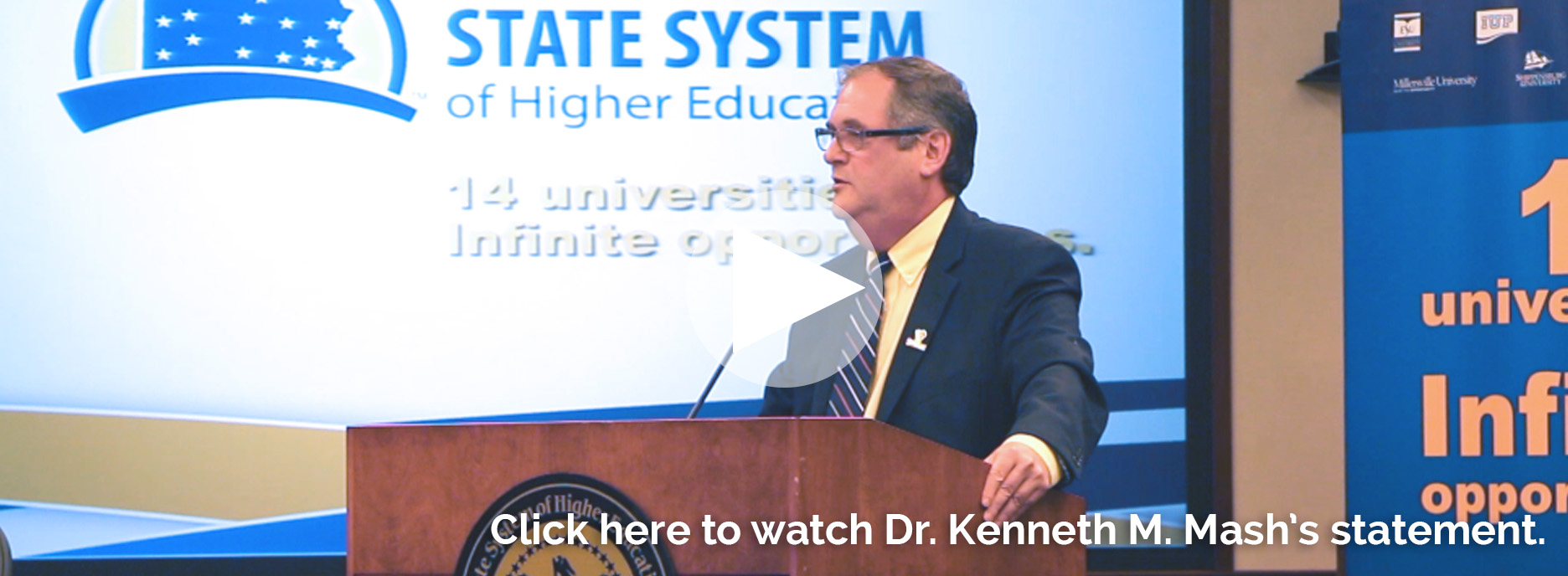
Mr. Chairman, members of board, Chancellor Brogan,
My name is Kenneth Mash, and I am the president of the Association of Pennsylvania State College and University Faculties, which represents the over 5,500 faculty and coaches at the 14 universities comprising our system.
I listened carefully to yesterday’s finance committee meeting, and I found it disturbing for a number of reasons. I heard it said, after some significant anti-union rhetoric, that “we are all in this together.” I want to make it clear that our faculty and our coaches most decidedly do not feel like we are in this together.
We don’t feel like we are in it together when we consistently hear rhetoric about the rising costs of professors, when the numbers simply do not bear that out. It may fit an anti-union narrative, but it doesn’t fit the facts. The reality is that over the last five years, with only a couple of exceptions, the instructional costs at our universities have been either level or have decreased. Instructional costs, which includes salary and benefits, is not a number that we make up. It is a number that the System reports to the federal government and can be calculated with the System’s own data.
We do not feel like we are in it together when faculty are blamed for increased costs when a look at spending on non-auxiliary capital expenditures shows that at most of our universities there has been an increase in proportional use of E&G money — money that is used for instruction, spent on these non-auxiliary capital expenditures. There is a clear mythology to the notion that there is a separate capital budget. The fact that our association was ignored when we pointed out the risks associated with the type of borrowing that was done, and that this board approved with nary a question asked, does not make us feel like we are on the same page.
We do not feel like we are all in it together when amid the years of an 18 percent cut and the following years of zero increases we felt like lonely voices speaking up about the long-term damage that was being done to public higher education. When we feel alone walking the halls of the legislature speaking up for our institutions.
We do not feel like we are all in it together when we are consistently told that we need to sacrifice when it is our faculty and coaches who have to pick up the pieces when there are fewer people around to serve students because of cuts and attrition, when we are the ones who have to make up for the cuts to student support with additional individualized student attention, when we are the ones coping with larger class sizes while maintaining rigor, when we are the ones who have seen our department budgets slashed, all while we are the ones who actually deliver the quality education that you all so consistently speak about.
We do not feel like we are all in it together as shared governance continually gives way to authoritarian-style decision-making that we repeatedly demonstrate is not undergirded by rationality.
We do not feel like we are all in it together when are still told about the rising costs of healthcare when we know that those costs have decreased.
We do not feel like we are in it together when faculty and coaches are unfairly and counterfactually attacked during a legislative hearing and the administration of this System does not correct the record and in some instances abets misunderstanding. Even worse, there was not a single mention about the need for a larger state allocation, only bragging about how we can do more with less by putting everything on the table.
We do not feel like we are in it together when some of the highest-paid people in the Commonwealth take pride in proposing cuts to some of the lowest-paid members of our organization while they continue to take increases, including some double-digit increases.
We do not feel like we are in it together when we know that campus budget projections are widely exaggerated, we see that be borne out, and then we are told that we just do not understand.
We do not feel like we are in it together to try to find a resolution to a contract when after 15 months of negotiation, the State System suddenly decides to drop 249 proposed changes to our CBA.
We do not feel like we are in it together when we believe that those changes include provisions that will undercut the quality of education that we deliver and hurt our students’ prospects.
We do not feel like we are in it together when we hear officials beat up on academic disciplines without any clear understanding of the value of those disciplines.
We do not feel like we are in it together when there seems to be a consistent push to mimic the private sector, to use corporate jargon, and to downgrade the nobility of public higher education, even as private sector ventures into higher education are proven disastrous on a nearly daily basis.
I could continue on this list for the next hour, but I will resist the temptation. Needless to say that we do not feel like we are in it together when there is too often clear anti-union and anti-faculty rhetoric that is bandied about in casual and formal conversation at these meetings.
If we are to move anything close to being in it together, there is a lot of work to be done. My fear is that time for that is ticking away too quickly. We are committed to moving in the direction of working together, but that cannot occur when policy decisions are written in stone before any real conversation begins.
I am always available to any one of you to respond to questions, to discuss facts on the ground, and to enrich our mutual understandings of each other’s perspectives. And we invite each of you to come to our campuses to speak to those many faculty and coaches who would welcome the opportunity to have your ear.
Thank you for your attention.