
Blog
‘We will do all we can to make sure the outcome is the best it can be for our students,’ APSCUF president says after vote
 Pennsylvania’s State System of Higher Education’s Board of Governors today voted to move forward with consolidation plans for three universities in western Pennsylvania (California, Clarion and Edinboro Universities of Pennsylvania) and three in the north (Bloomsburg, Lock Haven and Mansfield Universities of Pennsylvania).
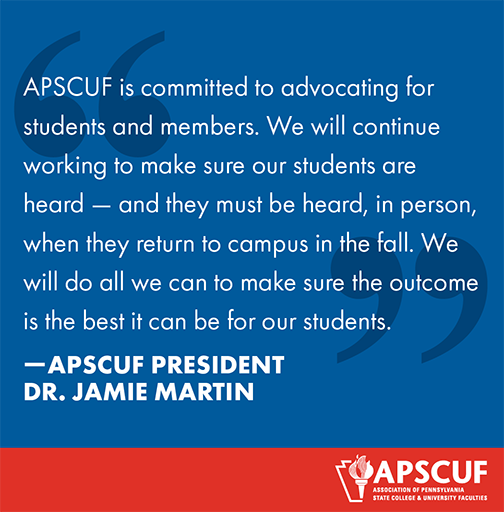
“APSCUF is committed to advocating for students and members. We will continue working to make sure our students are heard — and they must be heard, in person, when they return to campus in the fall,” APSCUF President Dr. Jamie Martin said in APSCUF’s statement following the vote. “We will do all we can to make sure the outcome is the best it can be for our students.”
Click here to read APSCUF’s complete statement.
Click here to read Martin’s comments to the Board of Governors at the beginning of today’s meeting, prior to the vote.
See Dr. Jamie Martin’s remarks to the Board of Governors – July 14, 2021
The July 14 Board of Governors meeting took place via Zoom and streamed via YouTube. Below are APSCUF President Dr. Jamie Martin’s comments as prepared.
Chairwoman Shapira, Chancellor Greenstein, governors and guests,
Today this board will consider a motion of monumental significance — one that would fundamentally alter the publicly funded university system, our 14 state-owned universities. I trust that the magnitude of today’s board action is one that none take lightly and is one that is made with careful consideration and with awareness of the role each will play in consolidating six of our universities into two.
I wish to speak today about the updated plans that this board will consider. We all heard and can read the public comments that were made about the initial consolidation plans. I need to point out that, despite some remarks to the contrary, the legitimate concerns raised by my colleagues were not raised because of self-interest. They were voiced because of the dedication that they have for our students, for our universities and for the State System — and their strong desire that all succeed. As APSCUF members, we shared our concerns for our students and the affordability of their higher-education opportunities and the importance of advocating for increased funding for the State System.
First, I need to give credit where credit is due. The updated consolidation plans include information that was missing in the April versions. This includes an economic-impact study. This study, along with the one completed in 2015 by the same consulting group, and the PERI report that was done by faculty at UMass-Amherst, draw the same conclusions: that our universities are the economic drivers in their home communities and, often, surrounding areas. The studies showed that the spending of faculty, staff and students, along with the tax revenue that they generate, are important sources of revenue for our university towns. For this and other reasons, we are happy that the updated plans specify that none of the six current universities can be closed — and we need to do all that we can to ensure that our students, staff and faculty remain at these universities.
We were pleased to learn of the three-year implementation of the curriculum array at the universities slated for consolidation, as this should permit time for more thoughtful development of graduate and undergraduate curriculum, including the general-education component and discipline-specific curricula — all of which will benefit our students.
There are still elements that are not included in the updated plans, and one is a detailed organizational chart, particularly for the academic-affairs division. I am sure some question why this is important and why I continue to point this out: It is important so that my colleagues can provide accurate information and advise current and future students about what departments and disciplines will exist and where they will be housed in the “New U’s.”
Over the past months, I have voiced my concerns — and those of my colleagues — for our students at the six consolidating universities. Questions and concerns still remain. For example, the guide to plan changes, a document that I believe will be presented today, states that there will be “relatively limited overall reliance on online modalities for residential students”; however, I cannot find this information detailed in the updated plans. Today I hope to hear more specific information about the extent to which our students will need to take online courses to complete their degrees. I have deep concerns about the student survey that is included in the updated plans. I will not address all of those concerns today. I will highlight, though, that the response rate is extremely low: For prospective students, it is 1%, and for current PASSHE students, it is 4%. You cannot draw any valid and meaningful conclusions from data that is based on a sample with such a meager response rate.
There are other important questions remaining. For example, what will happen to accredited programs on our campuses? Will an expensive and time-consuming reaccreditation be necessary for each of these? What will happen with Middle States accreditation? What about the decision of the NCAA permitting athletic teams to remain on all six campuses? These and other questions have not only been raised by my colleagues but many other stakeholders. We understand that these decisions are not required for the plans to move to a vote, but to dismiss their importance only exacerbates the fear and uncertainty of our faculty, students, staff and other stakeholder groups.
Our universities exist to provide access to an affordable, high-quality education for our students and to do all we can to help them succeed. As faculty and coaches, we see firsthand the importance of that affordability and access for our students and student-athletes, and in interactions with them we have learned that they lack important information about the consolidation. In my experience, too often decisions are made as if “we KNOW what is best for our students.” I have learned that they are quite capable of fully articulating what they believe is best for them. Their questions and concerns should be heard, and their input should be valued on a change this monumental, and the pandemic made hearing from them nearly impossible. Student feedback should still be sought when they return to our campuses — in person — in the fall.
Again, we recognize that some of these questions and concerns can’t be answered or addressed today. We trust that when the answers come, and as additional feedback and suggestions are given, they will guide the plan moving forward, will allow for course correction when new information or issues suggest it, and will allow for substantive changes, if warranted. This is important because many of my colleagues feel as if today’s action is “the end of the road” — the final step in consolidating six of our universities. I am encouraged to see in the guide to plan changes that, rather than the final step, this will be an iterative process and that what will be considered today is a planning document. There is too much at stake to consider it otherwise.
At an earlier BOG meeting, I used a quote by Winston Churchill, but it seems appropriate again. I hope that the plan considered today is “not the end. It is not even the beginning of the end. But it is, perhaps, the end of the beginning.”
Thank you for your time, and I wish all of you and your families continued good health.
From APSCUF member to officer-at-large, Mahfuzul Khondaker gives back through leadership
The same day Mahfuzul Khondaker signed his contract as associate professor at Kutztown University of Pennsylvania, he signed up to be a member of APSCUF.
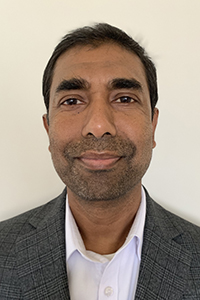
Mahfuzul Khondaker was elected an APSCUF officer-at-large in April. Photo courtesy of Mahfuzul Khondaker
“I knew what it (APSCUF) was,” he said. “(I) knew what they did for faculty.”
Khondaker understood how APSCUF’s mission affected the lives of faculty, staff and students at every level of the university, because he graduated from Indiana University of Pennsylvania with his doctorate. He earned his other degrees from the University of Dhaka in Bangladesh, where he taught for three years prior to attending IUP.
“(I) could see the role of APSCUF in state schools, so I came to a state school.” Khondaker said.
The State System alumnus said he wanted to give back to the Commonwealth.
“I had a responsibility to give back to people who contributed to my success,” he said.
Khondaker became involved with APSCUF through his Kutztown University chapter. As a new member with a young family, Khondaker felt wary of becoming too involved in any organization, he said. He wanted to start small; he joined the university-promotion committee in 2006, and became the committee’s chair in 2016. It became increasingly apparent that APSCUF occupied an important position in his life, he said.
Khondaker’s peers on the KU APSCUF executive council noticed his activity in the chapter. Tabetha Bernstein-Danis, Khondaker’s colleague and an APSCUF KU legislative-assembly delegate, commented on his growth as a member.
“I have seen Mahfuzul grow from being a presence within the KU community to really showing statewide APSCUF leadership,” Bernstein-Danis said. “He is now a member of the State APSCUF Executive Council. He is thoughtful and fair and is always trying to center the needs of faculty and students. He is very much an advocate for both of those constituencies.”
Before running for officer-at-large, Khondaker ran for president of the KU APSCUF chapter, and he ran for multiple committees in the 2010s. However, it was not until 2019 that he first thought about a leadership position in State APSCUF.

Kutztown University faculty member Mahfuzul Khondaker, right, learns about APSCUF’s labor-relations department from Mary Rita Duvall, head of the department, in 2019. APSCUF file photo
Khondaker’s faculty internship with the State APSCUF office granted him a new perspective on government and labor relations.
“I wanted to contribute more and have a better idea of what they (State APSCUF) do, or gain an appreciation for APSCUF state work,” he said.
After the faculty internship in Harrisburg, Khondaker followed a desire to advocate for others and in April won a position of officer-at-large.
His advocacy efforts influence his coursework as well. In the classroom, Khondaker teaches his students how to walk in another person’s shoes, and in his campaign platform he discussed a similar message.
“We want to make changes,” he said. “We have to understand each other. People in power need to do that. People that need it cannot make changes. Powerful people have power to make change.”
Seeing how retrenchment and consolidation cut individuals from the bottom resonated with Khondaker, and he made consolidation transparency and democracy key elements of his campaign platform. He addressed the human aspect of consolidation and financial cuts. Similar to his lectures, he proposed that people in charge see the world from another person’s perspective.
Examining the world from various angles means taking developments in policies and their effects on individuals seriously. Albert Fu, another legislative-assembly delegate for APSCUF KU, said that Khondaker’s position as chair of the university promotions committee involves this level of attention to detail.
“Promotion is governed by the collective bargaining agreement (CBA), which means Mahfuzul has had to be on top of changes in the CBA and ensure faculty know what is expected of them as well as their contractual rights,” Fu wrote in an email.
Thus, Khondaker, as officer-at-large, said he aims to help his fellow faculty members, students and staff members at every level. Regardless of the issue, one must reflect on how people view one another, something he supports in his APSCUF position, he said.
When he isn’t advocating for social justice in his community, you can find him reading or spending time gardening with his family. The Khondaker family recently received a beehive, so wish him luck with this newest outdoor adventure.
—Melissa Stough,
APSCUF intern
See Dr. Jamie Martin’s remarks to the Board of Governors – June 30, 2021
The June 30 Board of Governors meeting took place via Zoom and streamed via YouTube. Below are APSCUF President Dr. Jamie Martin’s comments as prepared.
Chairwoman Shapira, Chancellor Greenstein, governors and guests,
I will keep my comments brief today, as we are all eager to hear how you have incorporated the hundreds of comments, concerns and suggestions about the plans to consolidate six universities into two. I hope everyone will digest all the feedback available from a variety of sources.
The most important theme from the comments was concern for the impact on our students. Speaker after speaker expressed concerns about the difficulties that students faced in taking their courses via distance learning during the pandemic. These included a lack of broadband access, distractions at students’ residences that interfered with their classes, declining participation/engagement, and a resulting decline in performance. Many commenters wondered how a forced hybrid model at “New U’s” will affect the residential experience of our students and how that may impact enrollments. A recent study, which the State System conducted, provides a clue.
The Blue Beyond Consulting Group conducted this student survey at the three northern universities slated for consolidation. More than 1,300 students from Bloomsburg, Lock Haven and Mansfield responded to it. One of the first questions was this:
Imagine you are a potential incoming student for Fall 2022. With the new integrated university, you would have an expanded selection of majors to choose from but may have to take some classes via distance learning. How might the new array of offered programs and majors affect your decision to attend the integrated university?
The response to that question should raise concern, as approximately 60% of all students said they would be less likely to attend the New U.
Commenters wondered aloud about the program arrays that will exist across the campuses, and they asked questions about the location of departments at the New U’s. There are unanswered questions about the impact of consolidation on accredited programs, about the decision of the NCAA regarding athletic teams at the six campuses and about the number of online courses that students will be required to take.
I think we all agree that we must work together to improve our State System of Higher Education, and APSCUF is committed to partnering in that work. However, we believe that rather than doing something, we should strive to be certain that it is the right thing.
Students deserve answers to important questions, some of which I highlighted. Students at the six affected universities deserve face-to-face town-hall meetings when they return to campus in the fall. Based on the results of the student survey, it is imperative that student voices be heard and their questions and concerns addressed. If student input is not considered, and there are enrollment declines at the New U’s, how does that benefit our students? How does it help our students who rely on the universities in our State System to complete a degree and to improve their lives? Our students are the reason our State System exists, and we should all be willing to provide them an opportunity for input — and answers to their questions.
Thank you for your time.
Unusual year did not stop dedicated faculty, coaches: A roundup of 2020–21 accomplishments
During an academic year like no other, APSCUF’s members continued their work in their campus communities and beyond the gates of their universities.
Bloomsburg University’s Jennifer Haney, assistant professor of geography, directed a statewide recycling survey.
Kelton Edmonds from California University of Pennsylvania entered the New Pittsburgh Courier’s “Men of Excellence” class of 2021.
Cheyney University Professor Gooyong Kim delved further into the South Korean K-Pop perspective with publications this year.
Jane Walsh and Paul Klenowsk from Clarion University were chosen to perform research for the “I Fear For My Life Project” by the Frederick Douglass Institute Collaborative for the State System of Higher Education.
The Drexel Writing Festival welcomed Artress Bethany White, East Stroudsburg University associate professor of English, as a visiting author.
Jalen Middlebrooks became the first black female head coach at Edinboro University.
Professor Shundong Bi from Indiana University of Pennsylvania co-authored a paper on the discovery of a dinosaur preserved sitting on a nest of fossilized eggs.
Kutztown University’s head softball coach, Judy Lawes, secured her 1,000th career win.
Lock Haven University English Professor Marjorie Maddox’s poetry book won an award from The National Council of English Teachers.
Coach Edith Gallagher made history as the first female coach at Mansfield University to reach the 300- and 400-win milestones.
PRNews named Millersville University’s Jennifer Wood as its first Mentor of the Year.
Jen Clements from Shippensburg University found COVID-19 vaccinations for more than 600 people in Phase 1A.
Jeremy Lynch, associate professor of special education, and Nick Artman, assistant professor of communication, launched their podcast to recount Slippery Rock University stories.
West Chester University Professor Anita Foeman continued her work on DNA testing and its significance to African American identities and communities.
Thank you for your outstanding work, and please continue sharing your successes with APSCUF, so we can promote them across social media. Share your news by emailing .
—Melissa Stough,
APSCUF intern