Blog
There’s one week left to make our voices heard about university consolidations
We have one week to share our feedback about university consolidations, before the State System’s public-comment period ends June 30.
If you haven’t already:
- Submit written comments via the State System’s form.
- Write to Gov. Tom Wolf using this form.
Thank you to all who shared your stories and a feedback during the State System’s and APSCUF’s comment sessions.
Watch APSCUF’s sessions below:
June 3 – APSCUF public-comment recording session 1
June 8 – APSCUF public-comment recording session 2
June 14 – APSCUF public-comment recording session 3
Student recording
Cal U student Justina Arena recorded her statement with APSCUF June 15:
Learn more about consolidation on APSCUF’s Students page.
Nellie Bly Scholarship would be a game changer for State System students, supporters say
APSCUF President Dr. Jamie Martin and APSCUF intern Melissa Stough spoke about the need for state support of public higher education today during a press conference introducing the Nellie Bly Scholarship bill. Click here to read the bill, and click here to read more about how you can advocate for the plan to provide money to Pennsylvania’s State System of Higher Education students and help graduates earn their degrees with little to no student debt. Other speakers were Sen. Wayne Fontana, Sen. Tim Kearney, Tanya I. Garcia of Pennsylvania Department Of Education, and Adam Oldham of Pennsylvania School Counselors Association.
Read Martin’s comments as prepared:
Good morning. My name is Jamie Martin, and I am the president of the Association of Pennsylvania State College and University Faculties (APSCUF). APSCUF represents about 5,000 faculty and coaches who work at Pennsylvania’s fourteen state-owned universities.
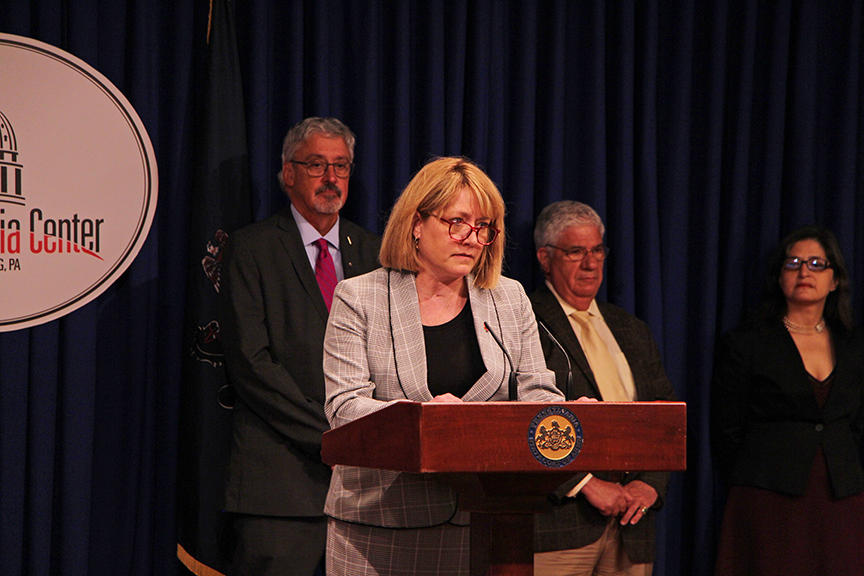
APSCUF President Dr. Jamie Martin discusses the student-debt crisis in Pennsylvania. “Luckily, there is a very real legislative solution proposed by these legislators committed to providing our amazing students with the support they deserve,” she said during a June 15 press conference introducing the Nellie Bly Scholarship bill. Photo/Kathryn Morton
Today I am proud to stand here on behalf of APSCUF and support the Nellie Bly Scholarship proposal. I want to thank Sen. Fontana, Rep. Harris, Gov. Wolf and all the supporters who have recognized the need for this game-changing scholarship proposal for our State System students.
We face a student-debt crisis here in Pennsylvania. Policy choices have led to devastating consequences for students attending public universities in the Commonwealth:
- Pennsylvania ranks 48th in average student-loan debt.
- Pennsylvania ranks 49th in student-loan debt per capita.
- The average student-loan debt in Pennsylvania is close to $40,000.
- And 66% of Pennsylvania students graduate with student-loan debt.
So what caused these rankings and this crisis?
- In 2001, Pennsylvania students covered 49% of their cost of college; in 2016, that number was 73%. We have moved from a state-funding model of public higher education to a student tuition-funded model.
- Depending on the metric and the source, Pennsylvania is consistently ranked 47th, 48th or 49th when it comes to funding for public higher education.
- Tuition at Pennsylvania public four-year colleges went up 26% between 2008 and 2018, and this is directly correlated to the inflation-adjusted 34% decline in state spending per student, and
- Pennsylvania spends about $3,500 LESS per public higher-education student than the national average.
A new report from the State Higher Education Executive Officers Association (SHEEO) shows that Pennsylvania saw the largest negative change in the nation in state general-operating appropriations between 2001 and 2019, with a drop of 53%.
This trend needs to stop, and, luckily, there is a very real legislative solution proposed by these legislators committed to providing our amazing students with the support they deserve. We cannot cut our way out of this funding and affordability crisis. Pennsylvania needs to take a moment to reassess our priorities and figure out creative ways to grow and strengthen our remarkable institutions of public higher education. That same SHEEO study shows that increased state funding leads to increased enrollment and improved graduation and completion rates. These are important outcomes.
The Nellie Bly Scholarship program would be a game changer for our Commonwealth and public higher education. Imagine the impact of these scholarships on the estimated 44,000 students attending a university in the State System of Higher Education who would be eligible recipients. These scholarships could assist the students who will become our future teachers, nurses, business owners and even legislators. The Nellie Bly Scholarship proposal puts students first and addresses both affordability and student debt. The overall impacts of this plan will be significant. Pennsylvania will realize a huge return on investment when students graduate with little to no debt and begin their careers in the Commonwealth. College graduates will contribute to the economy by buying vehicles and homes, becoming taxpayers, and spending dollars on Main Street rather than paying off loans to private lenders. This scholarship program will break down one of the largest barriers students face: cost. Think of the benefits to the students our state-owned universities serve, if students can focus on succeeding academically instead of how to make that tuition payment or being behind on their room and board.
APSCUF is proud to support this proposal that benefits students, fights student debt, benefits our economy, and develops our future workforce. We look forward to working with the legislature to pass this proposal.
I think it is important to hear how the Nellie Bly Scholarship program could benefit students — and to hear it from a student. I want to introduce Kutztown University student, Melissa Stough.
* * *
Read Stough’s comments as prepared:
Good morning! I am so honored to be here to discuss the importance of an affordable college education. I began my college journey at a private institution with very few students, but that promised to give me substantially more money than any state university. After I was pulled in by this promise of opportunity and financial aid, I began to realize the limitations of a private college education.
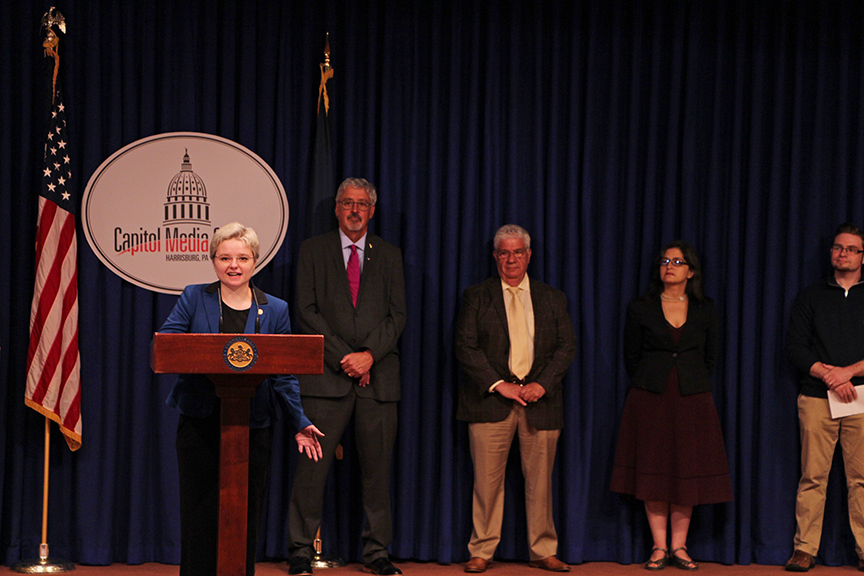
Melissa Stough, Kutztown University student and APSCUF intern, discusses how resources — including the proposed Nellie Bly Scholarship — make a difference for Pennsylvania students. Photo/Kathryn Morton
The campus lacked resources. We did not have a women’s center, an LGBTQ+ center or a multicultural center. I found myself feeling suffocated by this lack of access to resources and my peers expressed similar feelings to me in private. We were stuck. Without proper assistance, we could not afford a state university, but if we stayed at our private college, we would never be able to embrace our identities to the fullest extent or feel supported by the school’s governing bodies.
With resources such as the Nellie Bly Scholarship, students will not have to make that choice between embracing their identities and receiving an affordable, quality public education. I have seen firsthand the effects of student-loan debt as many friends had to withdraw from universities or take on three jobs to make ends meet. Friends suffered from financial and academic stress, taking a toll on their mental health, and negatively affecting their overall ability to achieve as a student.
The Nellie Bly Scholarship gives students an opportunity to hone their academic and professional skills, and give back to Pennsylvania communities in need. Much like Nellie Bly herself, who risked her credentials, her very livelihood in order to expose the flaws in the mental healthcare system in the 19th century, students are risking their financial and mental stability for the sake of pursuing higher education. However this is not the 19th century, so resources such as these are long overdue.
I’d like to conclude with a quote from Nellie Bly. She stated: “Energy rightly applied and directed will accomplish anything.”
By assisting students through greater funding and financial aid, you are rightly applying that energy toward Pennsylvania’s future leaders and ensuring our success.
Thank you.
Day 2: In hours of testimony, advocates urge Board of Governors to stop or delay consolidation plans
Members, students, alumni, staff and community members raised their voices today against plans to consolidate California, Clarion and Edinboro universities in the west and Bloomsburg, Lock Haven and Mansfield universities in the northeast. Pennsylvania’s State System of Higher Education’s third and four public-comment hearings yielded dozens more statements from stakeholders from across the 14 universities — none of them in favor of the plans proposed in late April. Most called for increased funding for public higher education in Pennsylvania, which ranks at or near the bottom in the country in measures of public higher-education investment.
For those unable to comment today or who have more to share, APSCUF plans additional comment-recording sessions next week. June 14 is open to all who register; June 15 is exclusively for students in the Zoom meeting, but we will livestream on Facebook for anyone to watch. Click here to register for next week’s events.
Watch the morning hearing below:
Watch the afternoon hearing, which lasted nearly three hours, below:
Read APSCUF’s collated tweets from both hearings:
In first day of hearings, speakers call on BOG to vote no or delay consolidation plans
Thank you to members, students, alumni and all others who spoke at today’s two State System hearing about plans to consolidate California, Clarion and Edinboro universities in the west and Bloomsburg, Lock Haven and Mansfield universities in the northeast. Two additional hearings are slated for 8 a.m. and 4:30 p.m. tomorrow, June 10.
By APSCUF’s count, 21 of the 23 morning speakers asked the Board of Governors to either vote no or to delay the plans. One speaker did not deliver remarks (She had intentions of speaking at a later session.) but asked where the board members were (They were not visible on the video.) and how they could be held accountable to hear public comments. (After a few seconds of silence, the answer was that BOG members had joined via Zoom or were watching on YouTube — but they were not onscreen panelists because they were not speaking.) Only one person — the remaining speaker — called the plans the “best option.” No afternoon speakers voiced support of the plans.
Watch the morning hearing, held in a webinar/panel style, below:
Watch the afternoon hearing below:
Read APSCUF’s collated tweets from both hearings:
This post has been updated to add information about the second hearing.
Speak out about consolidation this week
Wednesday kicks off the State System’s public-comment hearings about plans to consolidate California, Clarion and Edinboro universities in the west and Bloomsburg, Lock Haven and Mansfield universities in the northeast. Your feedback is valuable, and our solidarity is imperative. No matter what your university, you can make a difference by participating in one of the four hearings this week:
WEDNESDAY, JUNE 9:
STATE SYSTEM PUBLIC-COMMENT HEARINGS
8–9:30 a.m. and 4:30–6 p.m.
Click here to access the Zoom and YouTube links. We recommend joining the State System hearings through Zoom. Even if you don’t speak, consider joining via Zoom as a show of solidarity.
THURSDAY, JUNE 10:
STATE SYSTEM PUBLIC-COMMENT HEARINGS
8–9:30 a.m. and 4:30–6 p.m.
Click here to access the Zoom and YouTube links. We recommend joining the State System hearings through Zoom. Even if you don’t speak, consider joining via Zoom as a show of solidarity.
We’ve assembled some tips for you to consider, as you prepare to share your comments:
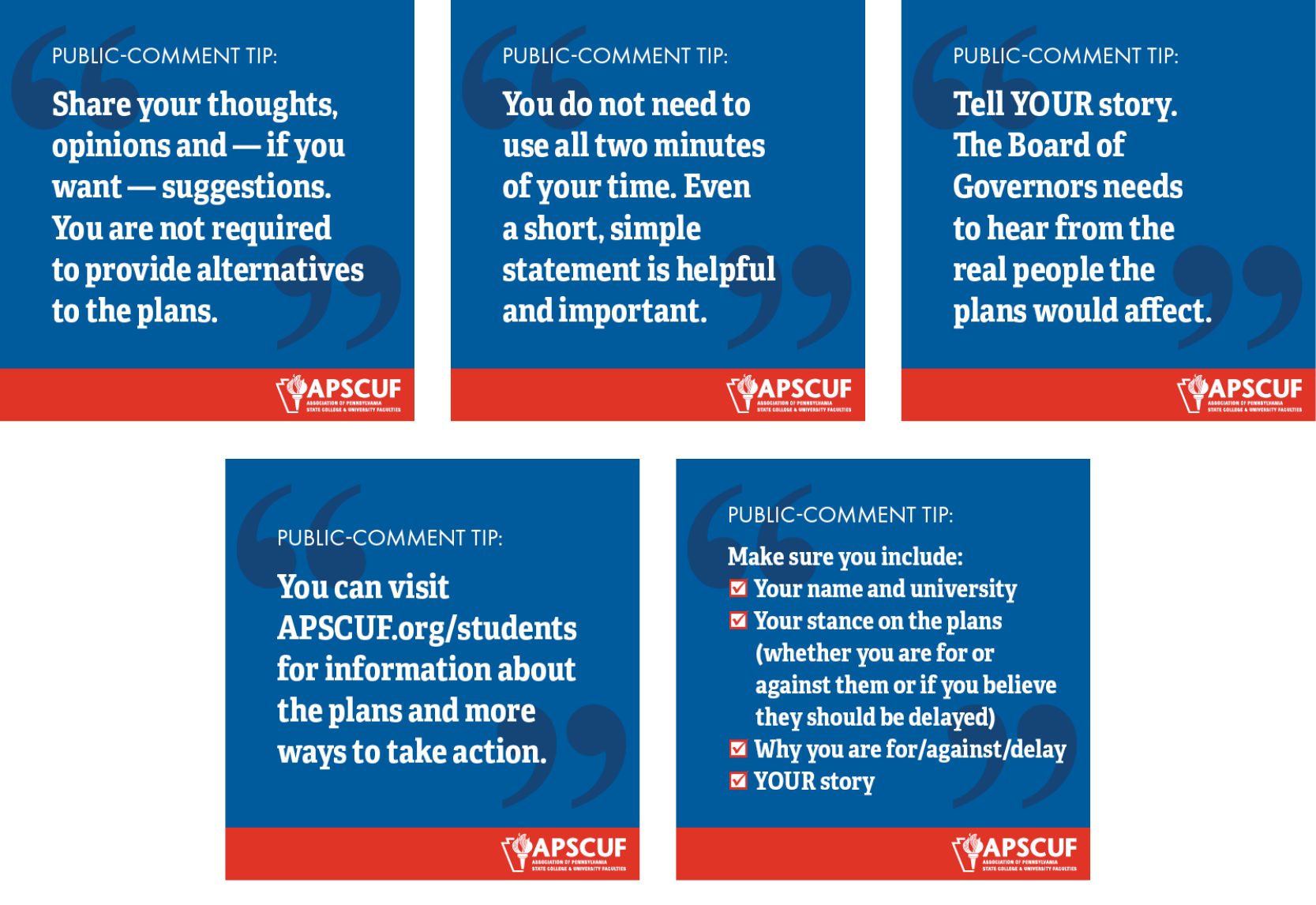
If you’re unable to attend one of the State System’s four sessions, APSCUF has two additional opportunities to document your comments on video. Click here to register for one of next week’s sessions and to watch previous recordings.
No matter what, we encourage you to submit written comments via the State System’s online portal.
Click here to learn more about consolidations and other ways you can take action.